

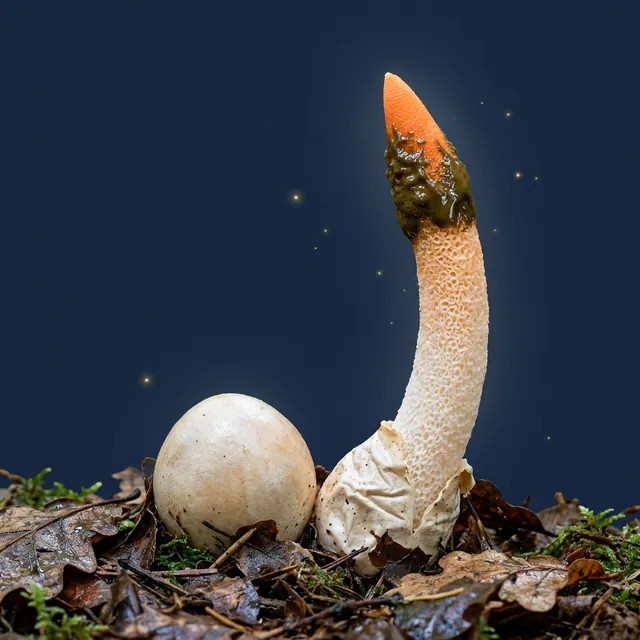
Dog stinkhorn
Mutinus caninus
Polish folk names: sromotnik psi, smardzik psi, smardz psi
How to recognise
- The young fruiting body is a whitish “egg” up to about 4 cm tall and 2.5 cm wide.
- The mature stalk is up to 16 cm tall and about 1 cm thick, white to cream.
- The tip is conical, covered with a sticky, dark olive spore mass; apricot or yellow-orange beneath it.
- The smell is pleasant in young ones, in older ones similar to the common stinkhorn but much weaker.
Up close
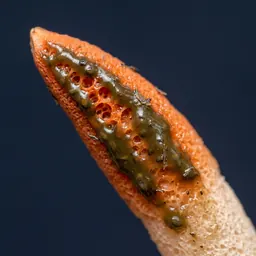 orange cone
Peak
Conical top covered with dark olive slime, orange beneath it; no separate head.
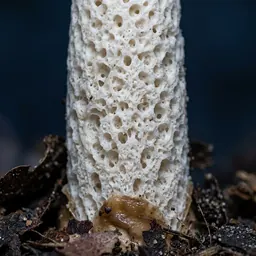 thin column
Stem
A slender, white to cream column up to 16 cm tall and about 1 cm thick.
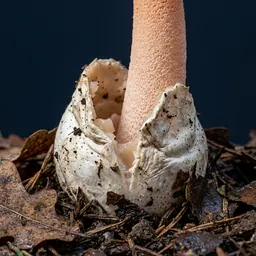 volva from the egg
Base
At the base a white, sac-like volva, the remains of the "egg" from which it grew.
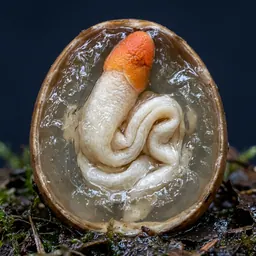 galareta
Cross-section of the egg
Whitish egg up to 4 cm; inside, jelly and the young column with an orange tip.
The close-ups are AI illustrations. Any doubt is settled by a mycologist or herbalist, not by a photo.
Where and when it grows
Damp, shady deciduous forests on fertile soils, usually in groups. In summer and autumn. Rare in Poland, Red List: V; no longer protected since 2014.
JanFebMarAprMayJunJulAugSepOctNovDec
Most often under: moist, shady broadleaved forests.
Beware of the lookalike
Common stinkhorn. The stinkhorn is larger, has a separate, bell-shaped head with a net and a strong smell of carrion. The dog stinkhorn has an orange, conical tip without a separate head.
Feature-by-feature comparison: Dog stinkhorn or Common stinkhorn?
Good to know
Niejadalny.
Frequently asked questions
Is dog stinkhorn edible?
No, dog stinkhorn is inedible. Niejadalny.
When does dog stinkhorn grow?
July – October. Damp, shady deciduous forests on fertile soils, usually in groups. In summer and autumn. Rare in Poland, Red List: V; no longer protected since 2014.
Dog stinkhorn: what is it easily confused with?
Most often with the species Common stinkhorn. The stinkhorn is larger, has a separate, bell-shaped head with a net and a strong smell of carrion. The dog stinkhorn has an orange, conical tip without a separate head.