

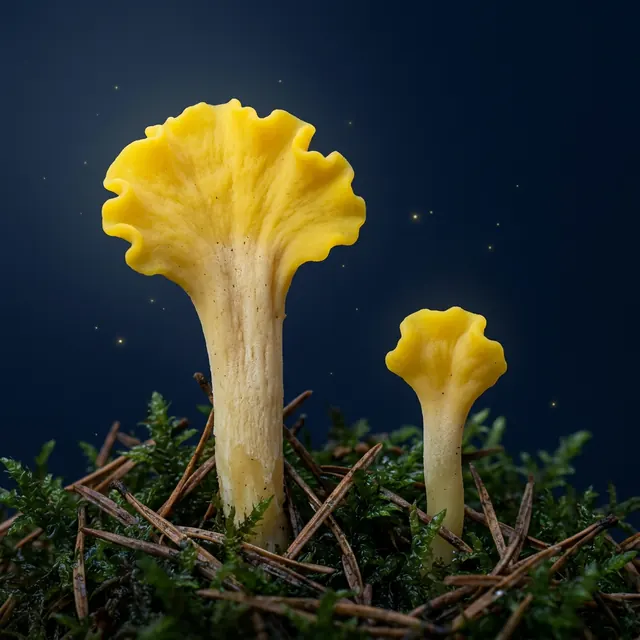
Yellow fan
Spathularia flavida
How to recognise
- Fruiting body usually up to 5 cm, at most 8 cm, made up of a head and a stem; the stem is often hidden in the leaf litter.
- Head 1–2.5 cm, roundish or spatula-shaped, flattened and folded, yellowish to olive-brown.
- Head clearly set off from the stem and more colourful than it.
- Stem 1–4 cm, white-yellow or lemon, thickened at the bottom.
Up close
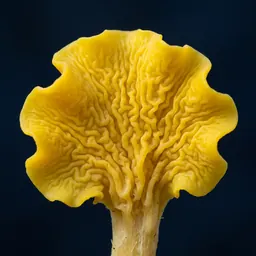 spatula
Flower head
Head yellow, flattened like a spatula or a fan, folded, running down both sides of the stem.
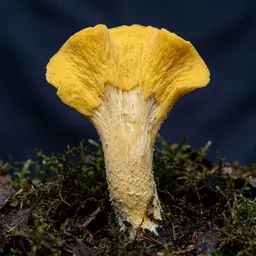 jasny
Stem
Stem whitish-yellow or lemon-coloured, paler than the head, thickened at the bottom.
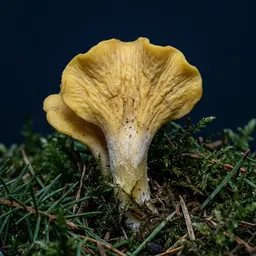 w igliwiu
Base of the stem
The stem is often hidden in moss or needles; the fruiting bodies grow singly, in groups or in arcs.
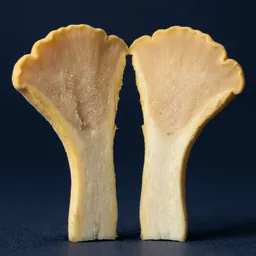 soft flesh
Cross-section
Flesh soft, pale, with a pleasant smell.
The close-ups are AI illustrations. Any doubt is settled by a mycologist or herbalist, not by a photo.
Where and when it grows
Forests and their edges, among mosses and grasses, on fallen needles; more often in the mountains than in the lowlands. In summer and autumn; rare in Poland.
JanFebMarAprMayJunJulAugSepOctNovDec
Most often under: coniferous forests, among mosses and needles, more often in the mountains.
Beware of the lookalike
Bog beacon. Mitróweczka has an orange, egg-shaped head on a thin, whitish stem and grows on peat bogs and in marshes.
Good to know
On the Red List of Fungi of Poland it has the status E (endangered). Considered edible, but because of its rarity it should not be collected.
Frequently asked questions
Is yellow fan edible?
No, yellow fan is inedible. On the Red List of Fungi of Poland it has the status E (endangered). Considered edible, but because of its rarity it should not be collected.
When does yellow fan grow?
July – October. Forests and their edges, among mosses and grasses, on fallen needles; more often in the mountains than in the lowlands. In summer and autumn; rare in Poland.
Yellow fan: what is it easily confused with?
Most often with the species Bog beacon. Mitróweczka has an orange, egg-shaped head on a thin, whitish stem and grows on peat bogs and in marshes.