

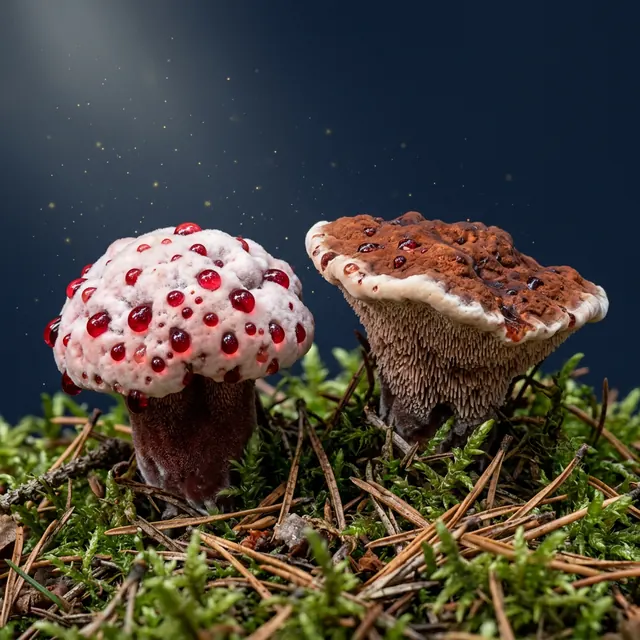
Hydnellum peckii
Hydnellum peckii
Strictly protected species
How to recognise
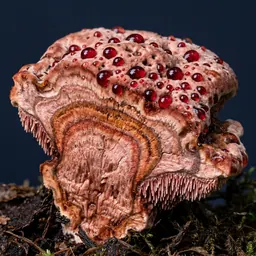
- Cap felty, white when young with blood-red drops of exudate, becoming rusty brown to brownish-black with age.
- Spines up to 5 mm, white, purple-brown with age, dense, running down the stem.
- Stem rusty brown to reddish-brown, solid, felty.
- Flesh corky, pink to rusty brown, zoned; taste burning.
Up close
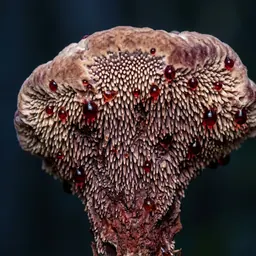 kolce
Underside of the cap
Underneath dense spines up to 5 mm, white, purple-brown with age, running down the stem.
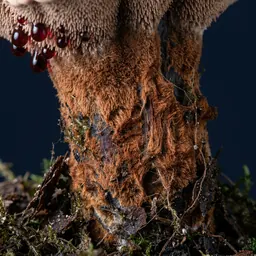 short, rusty
Stem
Short, rusty-brown, felty stem.
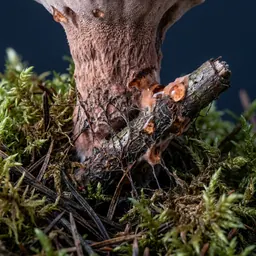 w igliwiu
Base of the stem
Grows from soil and moss in needle litter, sometimes overgrowing cones and sticks.
 strefowany
Cross-section
Flesh corky, pink to rusty-brown, with concentric zones.
The close-ups are AI illustrations. Any doubt is settled by a mycologist or herbalist, not by a photo.
Where and when it grows
Mountain coniferous forests, in mycorrhiza with pine and spruce, on the ground, sometimes on fallen cones. From summer to autumn. In Poland 16 sites up to 2020; status E – endangered.
JanFebMarAprMayJunJulAugSepOctNovDec
Most often under: pine, spruce (mountain pine forests).
Beware of the lookalike
Kolczakówka kasztanowata. Kolczakówka kasztanowata has flesh with a mild taste; both are protected.
Good to know
The red drops contain atromentin, a pigment with an anticoagulant effect. The mushroom is not known to be poisonous, but it is inedible because of its burning taste.
Frequently asked questions
Is hydnellum peckii edible?
No, hydnellum peckii is inedible. The red drops contain atromentin, a pigment with an anticoagulant effect. The mushroom is not known to be poisonous, but it is inedible because of its burning taste.
When does hydnellum peckii grow?
July – October. Mountain coniferous forests, in mycorrhiza with pine and spruce, on the ground, sometimes on fallen cones. From summer to autumn. In Poland 16 sites up to 2020; status E – endangered.
Hydnellum peckii: what is it easily confused with?
Most often with the species Kolczakówka kasztanowata. Kolczakówka kasztanowata has flesh with a mild taste; both are protected.