

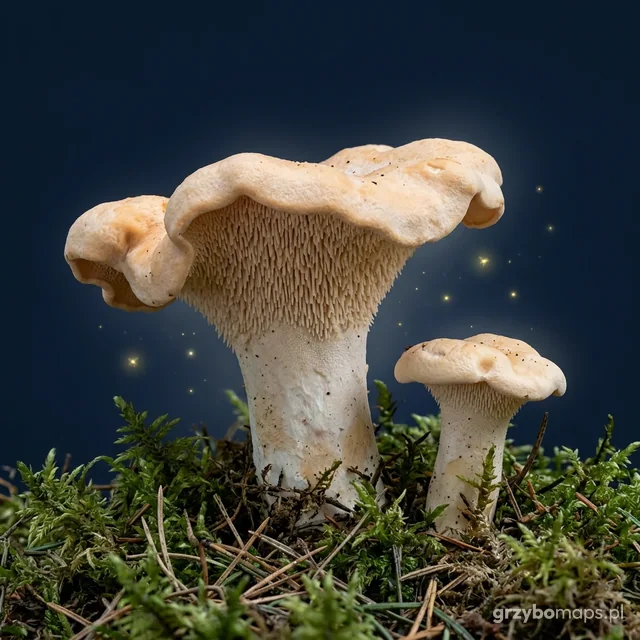
Wood hedgehog
Hydnum repandum
Polish folk names: kolczak
How to recognise
- Spines under the cap instead of gills and tubes
- Pleasant smell, old specimens bitter
Up close
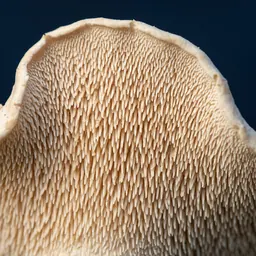 kolce
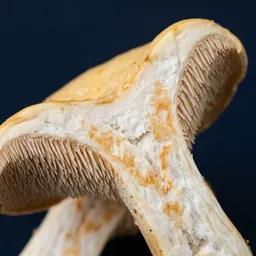
Underside of the cap
Under the cap there are dense, brittle, cream-coloured spines instead of gills and tubes.
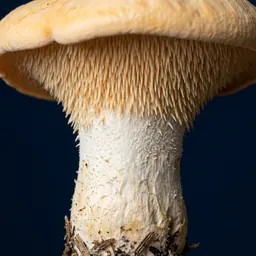 pale, solid
Stem
Stem short, thick, whitish, often set slightly off-centre; no ring.
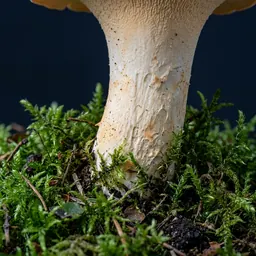 bez pochwy
Base of the stem
Base without a volva; grows on the ground among moss, often in rings.
 turns yellow
Cross-section
Flesh white, brittle; slowly turns orange-yellow where pressed.
The close-ups are AI illustrations. Any doubt is settled by a mycologist or herbalist, not by a photo.
Where and when it grows
Coniferous, deciduous and mixed forests, most often near spruce and beech. From July to October.
JanFebMarAprMayJunJulAugSepOctNovDec
Most often under: spruce, beech; coniferous and broadleaved forests.
Beware of the lookalike
Terracotta hedgehog. The terracotta hedgehog has a more intense, rusty colour. It is edible too.
Feature-by-feature comparison: Terracotta hedgehog or Wood hedgehog?
In the kitchen
Young ones are suitable for drying and pickling. Old specimens turn bitter.
Where in Poland
Most records in the GBIF database: małopolskie, wielkopolskie, zachodniopomorskie, świętokrzyskie, podlaskie.
Recipes with this mushroom
Frequently asked questions
Is wood hedgehog edible?
Yes, wood hedgehog is an edible mushroom.
When does wood hedgehog grow?
July – October. Coniferous, deciduous and mixed forests, most often near spruce and beech. From July to October.
Wood hedgehog: what is it easily confused with?
Most often with the species Terracotta hedgehog. The terracotta hedgehog has a more intense, rusty colour. It is edible too.
Where in Poland does wood hedgehog grow?
Most records (GBIF): małopolskie, wielkopolskie, zachodniopomorskie, świętokrzyskie, podlaskie. Most often under: spruce, beech; coniferous and broadleaved forests.