

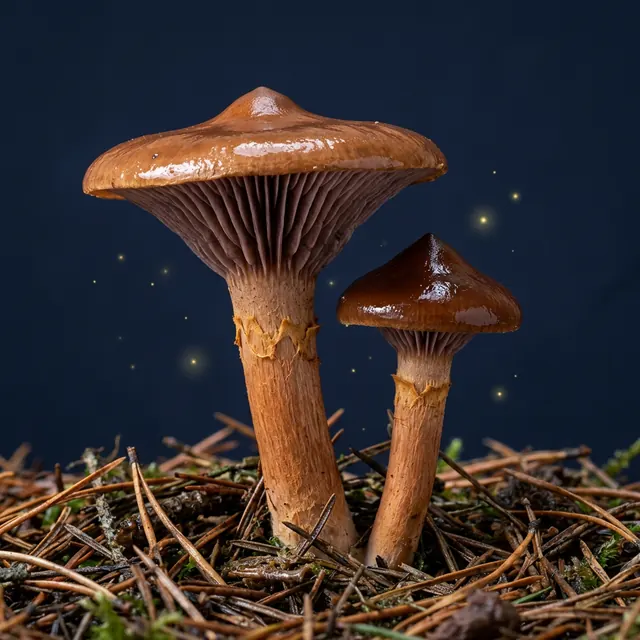
Copper spike-cap
Chroogomphus rutilus
Polish folk names: klejek lepki, klejówka lepka, czop jemiołak
How to recognise
- Cap 4–15 cm, copper-brown, strongly slimy when damp, smooth and shiny in drought.
- Gills very thick and sparse, often forked, deeply decurrent; first copper-grey, then dark purple-brown.
- Stem long and slender, copper-orange to yellowish-brown, with a zigzag pattern of the ochre veil.
- Flesh orange-yellow, chrome-yellow at the stem base; spore print olive-black.
Where and when it grows
Coniferous and mixed forests, under pine, fir and mountain pine, often on alkaline soils. From July to November; common in Poland.
JanFebMarAprMayJunJulAugSepOctNovDec
Most often under: pine, mountain pine, fir.
Beware of the lookalike
Deadly webcap. Confusion with deadly poisonous webcaps is possible. Klejek has thick, sparse, strongly decurrent, purple-brown gills, an olive-black spore print and orange-yellow flesh that turns carmine with time.
In the kitchen
Edible, of medium quality. Stew or fry; during cooking the flesh turns purple-red, as in the larch bolete (maślak sitarz).
Good to know
Do not collect it without experience: it can be confused with the deadly poisonous webcaps (zasłonak rudawy and zasłonak rudy).
Frequently asked questions
Is copper spike-cap edible?
Yes, copper spike-cap is an edible mushroom.
When does copper spike-cap grow?
July – November. Coniferous and mixed forests, under pine, fir and mountain pine, often on alkaline soils. From July to November; common in Poland.
Copper spike-cap: what is it easily confused with?
Most often with the species Deadly webcap. Confusion with deadly poisonous webcaps is possible. Klejek has thick, sparse, strongly decurrent, purple-brown gills, an olive-black spore print and orange-yellow flesh that turns carmine with time.