


Deadly webcap
Cortinarius rubellus
Polish folk names: zasłonak spiczasty, zasłonak czerwony
How to recognise
- Cap 3–8 cm, rusty-orange to brown, conical with a sharp bump, dry, fibrous.
- Gills distant, thick, rusty-brown.
- Stem the colour of the cap with yellowish, zigzag bands (remnants of the cortina).
- Smell faint, radish-like.
Up close
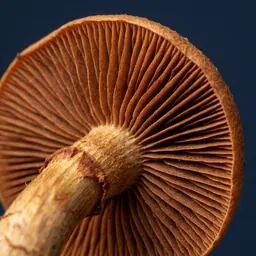 rdzawe blaszki
Underside of the cap
Gills distant, thick, rusty-brown.
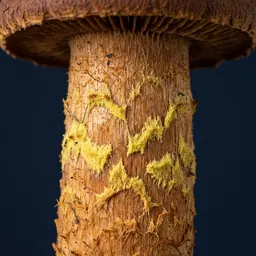 yellow bands
Stem
Stem the colour of the cap with yellow, zigzag bands.
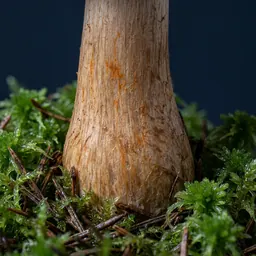 w mchu
Base of the stem
Base without a volva; grows in damp pine forests. Always twist out the whole mushroom.
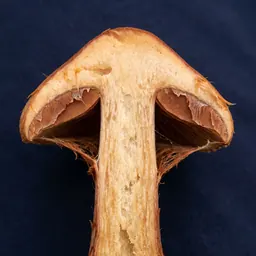 rzodkiewka
Cross-section
Flesh yellowish-orange, smell faint, like radish.
The close-ups are AI illustrations. Any doubt is settled by a mycologist or herbalist, not by a photo.
Where and when it grows
Damp coniferous forests, especially spruce forests with sphagnum moss, on acidic soils; from August to October.
JanFebMarAprMayJunJulAugSepOctNovDec
Most often under: spruce, pine.
Beware of the lookalike
Winter chanterelle (trumpet chanterelle). The chanterelle has blunt, forked ridges under the cap and a hollow, yellow stem. A webcap has true, rusty gills and a cobweb-like veil in young specimens.
Feature-by-feature comparison: Winter chanterelle or Deadly webcap?
Where in Poland
Most records in the GBIF database: pomorskie, dolnośląskie, podlaskie, świętokrzyskie, zachodniopomorskie.
Frequently asked questions
Is deadly webcap edible?
No. It is a deadly poisonous mushroom. Orellanine – damages the kidneys. Symptoms appear very late: after 2–20 days (most often 3–14): strong thirst, lower back pain, then acute kidney failure. No antidote, the toxin is not destroyed by cooking; dialysis or a kidney transplant is often necessary.
When does deadly webcap grow?
August – October. Damp coniferous forests, especially spruce forests with sphagnum moss, on acidic soils; from August to October.
Deadly webcap: what is it easily confused with?
Most often with the species Winter chanterelle (trumpet chanterelle). The chanterelle has blunt, forked ridges under the cap and a hollow, yellow stem. A webcap has true, rusty gills and a cobweb-like veil in young specimens.
Where in Poland does deadly webcap grow?
Most records (GBIF): pomorskie, dolnośląskie, podlaskie, świętokrzyskie, zachodniopomorskie. Most often under: spruce, pine.