

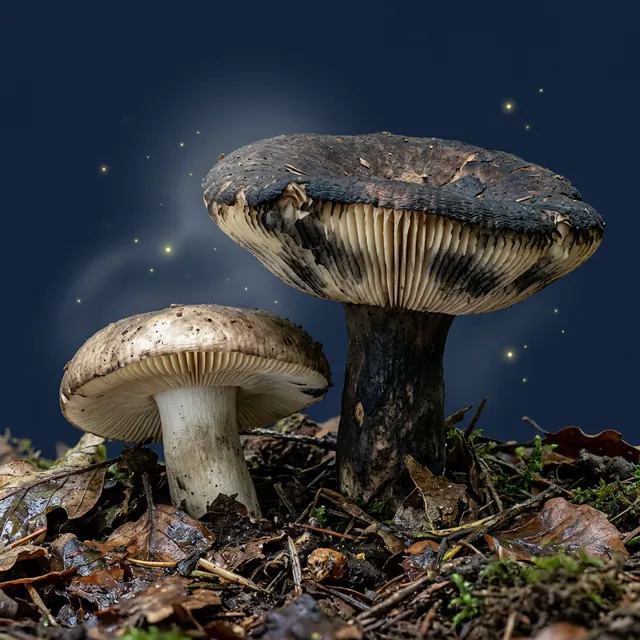
Blackening brittlegill
Russula nigricans
How to recognise
- Cap 10–20 cm, very hard, with an inrolled margin; whitish when young, then dark brown, finally black.
- Gills very thick, brittle and sparse, white, then blackening.
- Stem 2–7 cm tall and 1–3 cm thick, short, very hard, black with age.
- Flesh hard, when cut first turns red, then black; taste mild.
Where and when it grows
Deciduous and coniferous forests, under beeches and firs. From July to November; fairly common in Poland. The black fruiting bodies persist in the forest for several months.
JanFebMarAprMayJunJulAugSepOctNovDec
Most often under: beech, fir; deciduous and coniferous forests.
Beware of the lookalike
Gołąbek podpalany. Gołąbek podpalany has a cap that is paler near the margin, and its flesh turns red when cut but does not turn black. Gołąbek gęstoblaszkowy has more crowded gills.
Good to know
Edibility disputed: some guides list it as edible (young fruiting bodies only), others as inedible. In Poland there is no tradition of collecting it. For safety we mark it as inedible.
Frequently asked questions
Is blackening brittlegill edible?
No, blackening brittlegill is inedible. Edibility disputed: some guides list it as edible (young fruiting bodies only), others as inedible. In Poland there is no tradition of collecting it. For safety we mark it as inedible.
When does blackening brittlegill grow?
July – November. Deciduous and coniferous forests, under beeches and firs. From July to November; fairly common in Poland. The black fruiting bodies persist in the forest for several months.
Blackening brittlegill: what is it easily confused with?
Most often with the species Gołąbek podpalany. Gołąbek podpalany has a cap that is paler near the margin, and its flesh turns red when cut but does not turn black. Gołąbek gęstoblaszkowy has more crowded gills.