

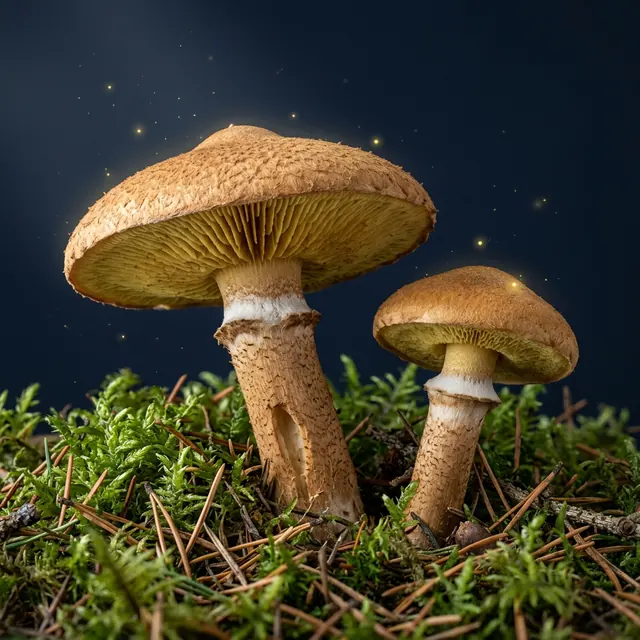
Hollow bolete
Suillus cavipes (Boletinus cavipes)
Partially protected species
Polish folk names: borowiec dęty, maślak dęty, borowik pustotrzonowy
How to recognise
- Cap 4–12 cm, with a small umbo, covered with fine darker fibrils, yellow-brown to red-brown.
- Tubes short, slightly decurrent; pores very large, radially elongated, yellow to yellow-olive, covered by a whitish veil when young.
- Stem 4–10 cm tall and 1–2 cm thick, hollow inside, with a whitish ring in the upper part.
- Flesh yellowish in the cap and white in the stem, does not change colour.
Up close
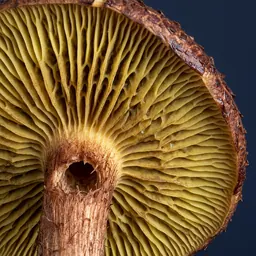 wielkie pory
Underside of the cap
Pores very large, angular, radially elongated, yellow to olive. They do not change colour.
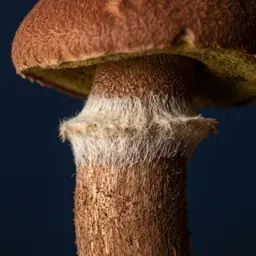 ring
Stem
Stem the colour of the cap or paler, with a whitish ring in the upper part.
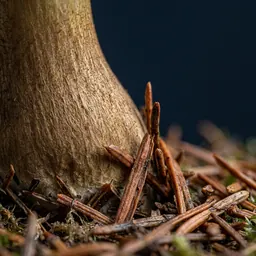 swollen
Base of the stem
Stem slightly thickened at the bottom. Always grows near larch.
 pusty trzon
Cross-section
Stem hollow inside. Flesh yellowish and white, does not change colour.
The close-ups are AI illustrations. Any doubt is settled by a mycologist or herbalist, not by a photo.
Where and when it grows
Exclusively under larches, more often in the mountains. From summer to autumn; over 80 sites in Poland, a rare species.
JanFebMarAprMayJunJulAugSepOctNovDec
Most often under: larch (exclusively).
Beware of the lookalike
Larch bolete. The larch bolete also grows under larch, but has a smooth, slimy, golden-yellow cap, small pores and a solid stem with a distinct ring.
In the kitchen
Protected species – do not collect it. Leave it in the forest and enjoy the sight.
Frequently asked questions
Is hollow bolete edible?
Yes, hollow bolete is an edible mushroom.
When does hollow bolete grow?
July – October. Exclusively under larches, more often in the mountains. From summer to autumn; over 80 sites in Poland, a rare species.
Hollow bolete: what is it easily confused with?
Most often with the species Larch bolete. The larch bolete also grows under larch, but has a smooth, slimy, golden-yellow cap, small pores and a solid stem with a distinct ring.