

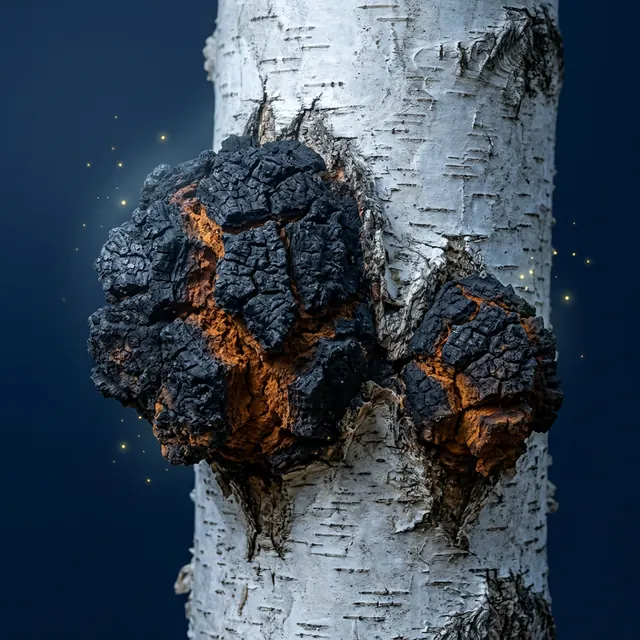
Inonotus obliquus (chaga)
Inonotus obliquus
Partially protected species
Polish folk names: czaga, huba ukośna, huba skośnorurkowa, czarna huba, włóknouszek ukośny, błyskoporek ukośny
How to recognise
- The visible part is a perennial, sterile growth (up to 50 cm), strongly fused with the trunk at the side.
- Surface blackish-brown, hard, cracked and knobbly, like charred wood or slag.
- In fresh cracks and inside rusty brown or yellow-brown.
- The sexual fruiting body with tubes forms only after the tree has died, under the bark, and is hard to see.
Up close
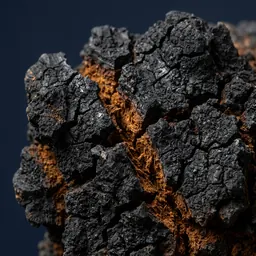 charred crust
Surface
Black, hard, deeply cracked surface, like charred wood or slag.
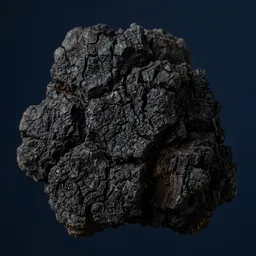 shapeless growth
Shape
Knobby, irregular growth without a cap, stem or pores, up to 50 cm.
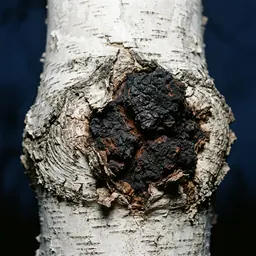 grown into the trunk
Attachment to wood
Strongly fused with the trunk of a living birch; the trunk around it may be thickened.
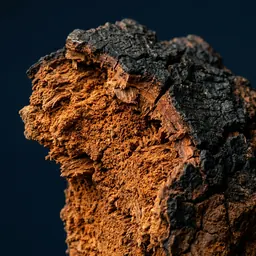 rusty interior
Cross-section
Interior hard, rusty-brown or yellow-brown, contrasting with the black crust.
The close-ups are AI illustrations. Any doubt is settled by a mycologist or herbalist, not by a photo.
Where and when it grows
Trunks of living deciduous trees, in Poland mainly birches, less often aspen and others; in forests, less often in parks. Visible all year round; rare in Poland.
JanFebMarAprMayJunJulAugSepOctNovDec
Most often under: birch, less often aspen, alder, maple, beech, hornbeam, elm.
Beware of the lookalike
Growths and burls on a birch trunk. Ordinary growths (burls) on birch are covered with bark and have wood inside. Chaga is black, crumbly and cracked, and rusty brown inside.
Good to know
A parasite causing white rot and usually the death of the tree. Chaga infusions are popular in folk medicine, but their effectiveness and safety have not been confirmed in clinical studies. Chaga contains a great deal of oxalates: severe kidney damage (oxalate nephropathy), including irreversible damage requiring dialysis, has been described after long-term drinking or eating of powdered chaga. It may also intensify the effect of anticoagulant and blood-sugar-lowering drugs. People with kidney disease or taking such drugs should talk to a doctor.
Frequently asked questions
Is inonotus obliquus edible?
No, inonotus obliquus is inedible. A parasite causing white rot and usually the death of the tree. Chaga infusions are popular in folk medicine, but their effectiveness and safety have not been confirmed in clinical studies. Chaga contains a great deal of oxalates: severe kidney damage (oxalate nephropathy), including irreversible damage requiring dialysis, has been described after long-term drinking or eating of powdered chaga. It may also intensify the effect of anticoagulant and blood-sugar-lowering drugs. People with kidney disease or taking such drugs should talk to a doctor.
When does inonotus obliquus grow?
January – December. Trunks of living deciduous trees, in Poland mainly birches, less often aspen and others; in forests, less often in parks. Visible all year round; rare in Poland.
Inonotus obliquus: what is it easily confused with?
Most often with the species Growths and burls on a birch trunk. Ordinary growths (burls) on birch are covered with bark and have wood inside. Chaga is black, crumbly and cracked, and rusty brown inside.