

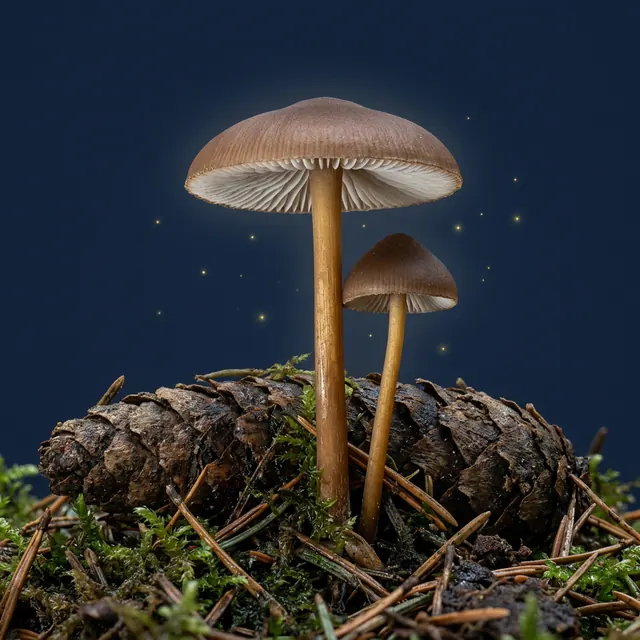
Strobilurus esculentus
Strobilurus esculentus
Polish folk names: pieniążek szyszkowy
How to recognise
- Cap 1.5–2.5 cm, exceptionally 3.5 cm, hemispherical to flat, grey-ochre to dark brown, smooth and matt.
- Gills crowded, whitish to light ash-grey.
- Stem 3–6 cm tall and 1–2 mm thick, stiff, tubular, brown-ochre, lighter at the top.
- Grows from spruce cones, often partly buried in the ground.
Up close
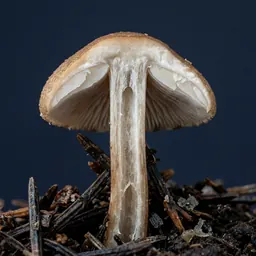
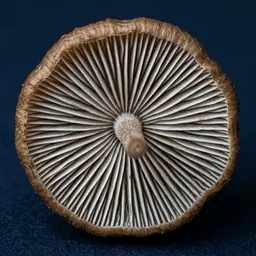 whitish gills
Underside of the cap
Gills crowded, sinuate (notched), whitish to pale ash-grey.
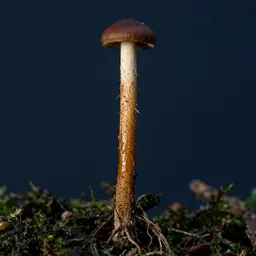 stiff, thin
Stem
Stem thin, stiff, tubular, shiny, brown-ochre, paler at the top.
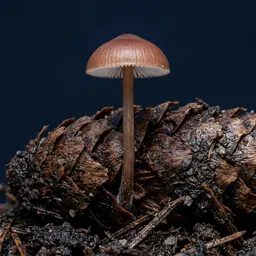 z szyszki
Base of the stem
The stem grows from a buried spruce cone; when dug up, the cone with remains of mycelium is visible.
 thin flesh
Cross-section
Flesh thin, whitish, without smell, taste mild.
The close-ups are AI illustrations. Any doubt is settled by a mycologist or herbalist, not by a photo.
Where and when it grows
Forests, parks and cemeteries with spruces, especially in the mountains; on buried spruce cones, exceptionally fir cones. Mainly from March to June, less often in October and November.
JanFebMarAprMayJunJulAugSepOctNovDec
Most often under: spruce cones in the leaf litter.
Beware of the lookalike
Pieniążniczka szyszkowa. Pieniążniczka also grows on spruce cones, but mainly in autumn, has very crowded gills and is inedible. Check that the cone is a spruce cone.
In the kitchen
Eat only the caps. Stew in butter for at least 15 minutes and serve on toast; a good spring addition.
Frequently asked questions
Is strobilurus esculentus edible?
Yes, strobilurus esculentus is an edible mushroom.
When does strobilurus esculentus grow?
March, April, May, June, October, November. Forests, parks and cemeteries with spruces, especially in the mountains; on buried spruce cones, exceptionally fir cones. Mainly from March to June, less often in October and November.
Strobilurus esculentus: what is it easily confused with?
Most often with the species Pieniążniczka szyszkowa. Pieniążniczka also grows on spruce cones, but mainly in autumn, has very crowded gills and is inedible. Check that the cone is a spruce cone.