

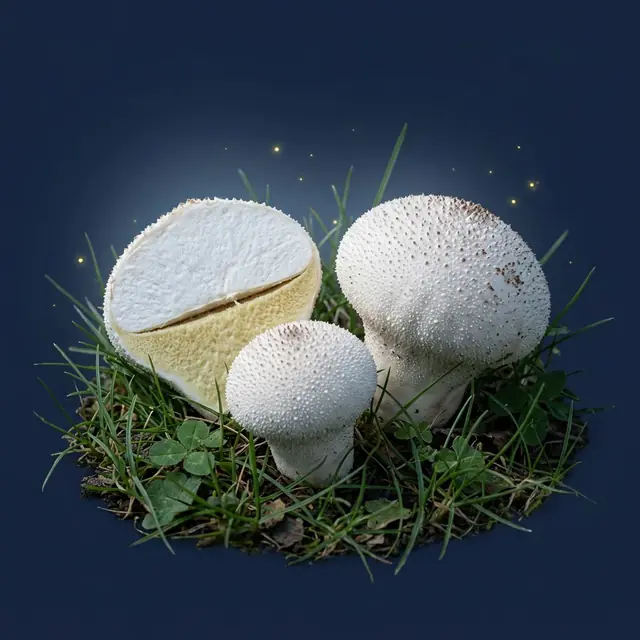
Meadow puffball
Lycoperdon pratense (syn. Vascellum pratense)
Polish folk names: purchaweczka spłaszczona
How to recognise
- Fruiting body 2–5 cm, spherical but clearly flattened, with a short, narrowed base.
- Skin white with small spines and granules that the rain quickly washes off.
- In cross-section a distinct membrane (diaphragm) separates the spore-bearing part from the spongy base.
- When mature it turns brown, opens with a wide hole and releases brown dust.
Where and when it grows
Meadows, pastures, lawns, parks and roadsides, in short grass. From June to November.
JanFebMarAprMayJunJulAugSepOctNovDec
Most often under: meadows, pastures, lawns, roadsides.
Beware of the lookalike
Common earthball. The earthball has a thick, yellowish, cracked skin and is dark, violet-black inside from the start. A young puffball is snow-white inside.
In the kitchen
Only young ones, white inside. Peel, slice and fry in breadcrumbs like a cutlet.
Good to know
Edible only when young, when it is uniformly snow-white in cross-section. Cut every puffball in half: if you can see the outline of a cap and gills, it may be a young, deadly poisonous Amanita.
Frequently asked questions
Is meadow puffball edible?
Warunkowo. Edible only when young, when it is uniformly snow-white in cross-section. Cut every puffball in half: if you can see the outline of a cap and gills, it may be a young, deadly poisonous Amanita.
When does meadow puffball grow?
June – November. Meadows, pastures, lawns, parks and roadsides, in short grass. From June to November.
Meadow puffball: what is it easily confused with?
Most often with the species Common earthball. The earthball has a thick, yellowish, cracked skin and is dark, violet-black inside from the start. A young puffball is snow-white inside.