

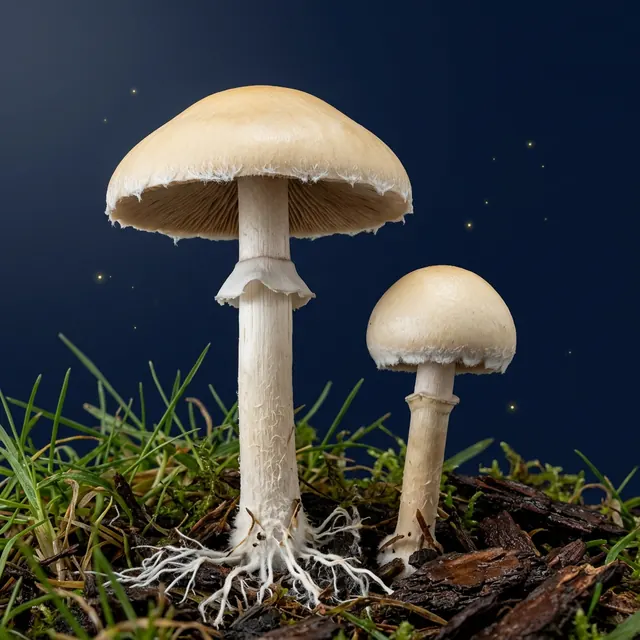
Spring fieldcap
Agrocybe praecox
Polish folk names: łuskwiak wczesny, bedłka tarniówka, łuskwiak tarniówka
How to recognise
- Cap 2–8 cm, smooth, yellowish, creamy white, ochre or brownish, usually with whitish remnants of the veil on the margin.
- Gills dense, notched, whitish, then clay-brownish.
- Stem 4–9 cm tall and 4–9 mm thick, hollow, with a membranous, drooping ring and white cords of mycelium at the base.
- Flesh whitish, brown in the stem; smell faint, mealy, taste mealy-slightly bitter.
Up close
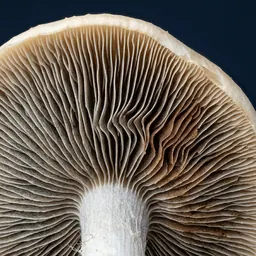 gills turning brown
Underside of the cap
Gills crowded, whitish, then greyish-white and clay-brown. Spore print brown.
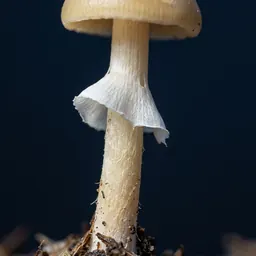 drooping ring
Stem
Stem whitish to cream-ochre, hollow, with a membranous, drooping ring.
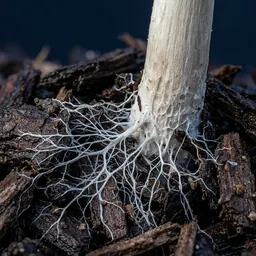 white cords
Base of the stem
Base with white rhizomorphs (cords of mycelium), grown into leaf litter or bark.
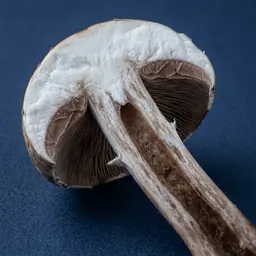 brown in the stem
Cross-section
Flesh whitish and soft in the cap, brown in the stem. Does not change colour.
The close-ups are AI illustrations. Any doubt is settled by a mycologist or herbalist, not by a photo.
Where and when it grows
Grassy forest edges, thickets, glades, pastures, parks, gardens, orchards, roadsides; on wood remains, bark, sawdust and litter. From May to July; common.
JanFebMarAprMayJunJulAugSepOctNovDec
Most often under: lawns, gardens, forest edges, bark and sawdust.
Beware of the lookalike
Polówka popękana. Polówka popękana is larger, has compact flesh and a cap cracked into patches; it grows in dry places outside the forest.
In the kitchen
Stew or fry young caps for at least 15 minutes, best as an addition to other mushrooms. The stems are fibrous.
Frequently asked questions
Is spring fieldcap edible?
Yes, spring fieldcap is an edible mushroom.
When does spring fieldcap grow?
May – July. Grassy forest edges, thickets, glades, pastures, parks, gardens, orchards, roadsides; on wood remains, bark, sawdust and litter. From May to July; common.
Spring fieldcap: what is it easily confused with?
Most often with the species Polówka popękana. Polówka popękana is larger, has compact flesh and a cap cracked into patches; it grows in dry places outside the forest.