

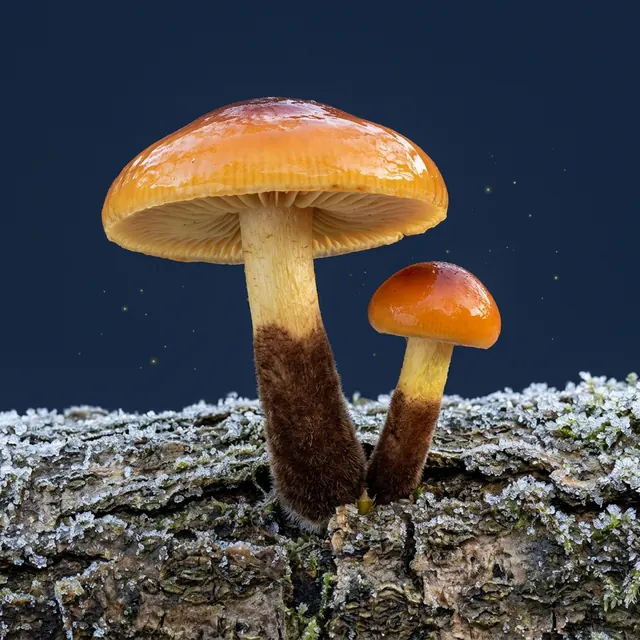
Velvet shank (enoki)
Flammulina velutipes
Polish folk names: zimówka aksamitna, monetka aksamitna, opieńka aksamitnotrzonowa
How to recognise
- Cap 1–7 cm, yellow-orange to yellow-brown, smooth, very slippery and shiny when damp.
- Gills sparse, whitish, then ochre-yellow.
- Stem 5–10 cm, 3–8 mm thick, yellow at the top, blackish-brown and velvety below, without a ring.
- Spore print white; the fruiting bodies are frost-resistant.
Up close
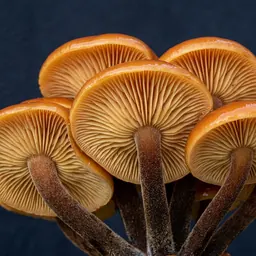 rzadkie blaszki
Underside of the cap
Gills distant, whitish, then ochre-yellow, rounded at the stem.
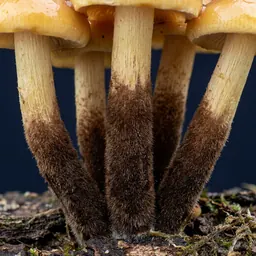 velvety, dark
Stem
Stem yellow at the top, blackish-brown at the bottom, covered with a velvety suede. No ring.
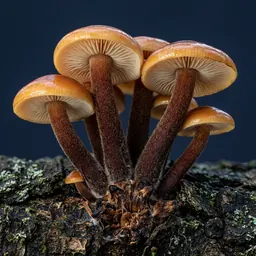 clump on wood
Base of the stem
Stems fused at the base into a clump, growing from the bark of a trunk or stump.
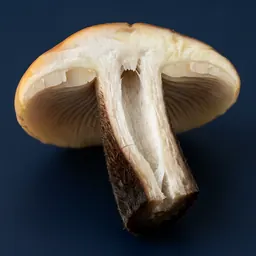 thin flesh
Cross-section
Flesh thin, whitish to cream, fibrous in the stem, does not change colour.
The close-ups are AI illustrations. Any doubt is settled by a mycologist or herbalist, not by a photo.
Where and when it grows
Trunks, stumps and branches of deciduous trees, most often poplar and willow, in forests, parks and gardens, in clumps. From October to December, in mild winters until March.
JanFebMarAprMayJunJulAugSepOctNovDec
Most often under: poplar, willow and other deciduous trees.
Beware of the lookalike
Funeral bell. The galerina has a rusty-brown spore print, a ring or ring zone and a pale, fibrous stem. The velvet shank has a white spore print and a velvety, dark stem without a ring.
Feature-by-feature comparison: Velvet shank or Funeral bell?
In the kitchen
Use the caps only, the stems are fibrous. Boil or fry for at least 15 min; good for soups and pickles.
Good to know
It is also cultivated (enoki), but cultivated fruiting bodies are white and long. The wild one is easy to confuse with the deadly galerina, so check the spore print.
Frequently asked questions
Is velvet shank edible?
Yes, velvet shank is an edible mushroom.
When does velvet shank grow?
January, February, March, October, November, December. Trunks, stumps and branches of deciduous trees, most often poplar and willow, in forests, parks and gardens, in clumps. From October to December, in mild winters until March.
Velvet shank: what is it easily confused with?
Most often with the species Funeral bell. The galerina has a rusty-brown spore print, a ring or ring zone and a pale, fibrous stem. The velvet shank has a white spore print and a velvety, dark stem without a ring.