

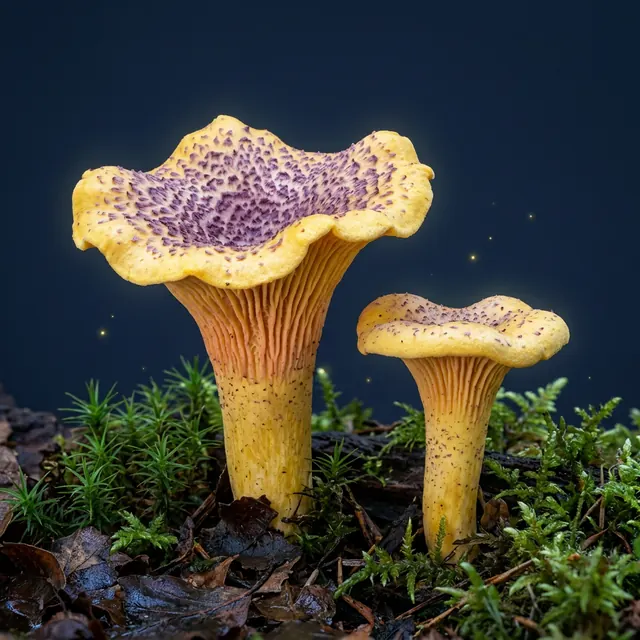
Amethyst chanterelle
Cantharellus amethysteus
How to recognise
- Cap 2–8 cm, yellow, covered with violet down that dries into small scales in older ones, especially in the centre.
- Hymenophore of ridges running deeply down the stem, forked and cross-linked, yellow-orange, often pinkish.
- Stem 3–7 cm tall and up to 2.5 cm thick, hard, yellow, blending smoothly into the cap.
- Flesh pale yellow, springy and hard; smell faint, fruity.
Up close
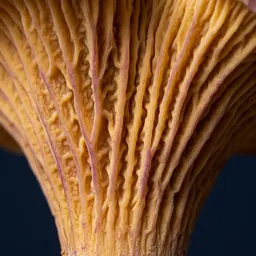 rozwidlone listewki
Underside of the cap
Decurrent ridges, strongly forked and cross-connected, yellow-orange with a pink tinge.
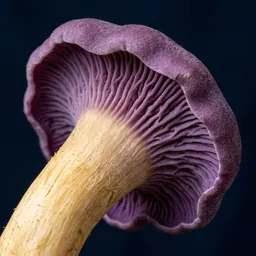 yellow, hard
Stem
Stem yellow, hard, widens in a cone shape into the cap.
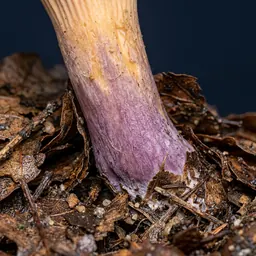 narrowed
Base of the stem
Stem narrows downwards; grows in beech litter or in moss under spruce.
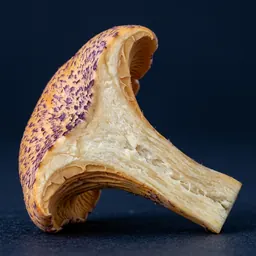 fioletowy nalot
Cross-section
Flesh pale yellow and hard; violet scales visible on top of the cap.
The close-ups are AI illustrations. Any doubt is settled by a mycologist or herbalist, not by a photo.
Where and when it grows
Beech woods and mountain spruce forests, in grass and on fallen leaves, on acidic soils. From July to August, singly from June to September; rare in Poland.
JanFebMarAprMayJunJulAugSepOctNovDec
Most often under: beech, spruce, fir, also birch, oak.
Beware of the lookalike
Chanterelle. The common chanterelle has no violet bloom on the cap and has less wavy ridges. Both are edible.
Feature-by-feature comparison: Amethyst chanterelle or Chanterelle?
In the kitchen
Like the chanterelle: fried in butter with onion for 15–20 minutes, for scrambled eggs or a sauce. It is tougher and harder to digest, so cut it finely and stew it well.
Frequently asked questions
Is amethyst chanterelle edible?
Yes, amethyst chanterelle is an edible mushroom.
When does amethyst chanterelle grow?
June – September. Beech woods and mountain spruce forests, in grass and on fallen leaves, on acidic soils. From July to August, singly from June to September; rare in Poland.
Amethyst chanterelle: what is it easily confused with?
Most often with the species Chanterelle. The common chanterelle has no violet bloom on the cap and has less wavy ridges. Both are edible.