

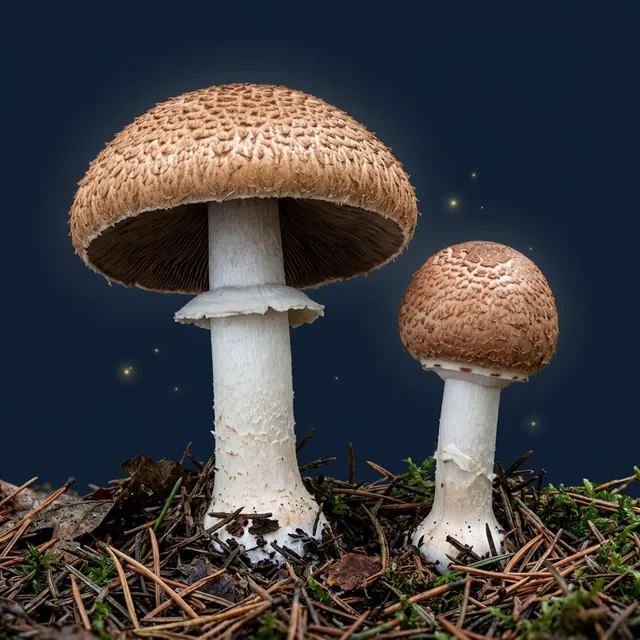
Blushing wood mushroom
Agaricus sylvaticus
Polish folk names: pieczarka lśniąca
How to recognise
- Cap 3–10 cm, dark brown to ochre, densely covered with cinnamon-brown, fibrous scales.
- Gills crowded, free, greyish-reddish, dark brown in older ones.
- Stem 5–12 cm, 1–2 cm thick, white, with a spreading ring, bulbously swollen at the bottom.
- Flesh white, turns red when cut; spore print blackish-brown.
Up close
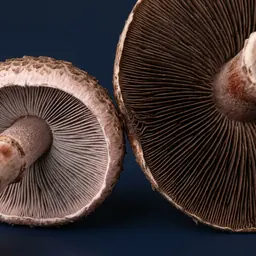 ciemne blaszki
Underside of the cap
Gills free, crowded, greyish-red when young, then dark brown with paler edges.
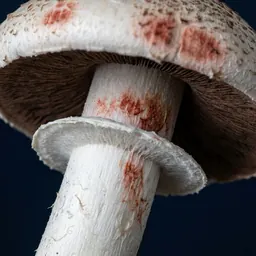 spreading ring
Stem
Stem white with a spreading ring; turns red when pressed, then brown.
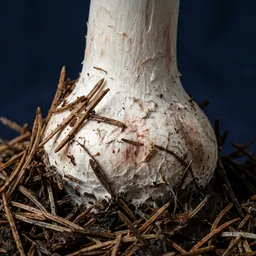 bulwka
Base of the stem
Base swollen into a bulb, without a volva, does not turn yellow.
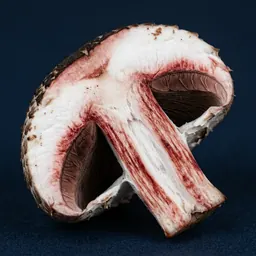 czerwienieje
Cross-section
Flesh white, clearly turns red when cut.
The close-ups are AI illustrations. Any doubt is settled by a mycologist or herbalist, not by a photo.
Where and when it grows
Coniferous and mixed forests, less often deciduous, also meadows and parks; most often under spruce and fir. From June to October.
JanFebMarAprMayJunJulAugSepOctNovDec
Most often under: spruce, fir; also alder, willow.
Beware of the lookalike
Yellow stainer. The yellow stainer smells of carbolic acid, and the base of its stem turns yellow when cut. The blushing wood mushroom turns red and has no unpleasant smell.
In the kitchen
Fry or stew for 15–20 min.
Frequently asked questions
Is blushing wood mushroom edible?
Yes, blushing wood mushroom is an edible mushroom.
When does blushing wood mushroom grow?
June – October. Coniferous and mixed forests, less often deciduous, also meadows and parks; most often under spruce and fir. From June to October.
Blushing wood mushroom: what is it easily confused with?
Most often with the species Yellow stainer. The yellow stainer smells of carbolic acid, and the base of its stem turns yellow when cut. The blushing wood mushroom turns red and has no unpleasant smell.