

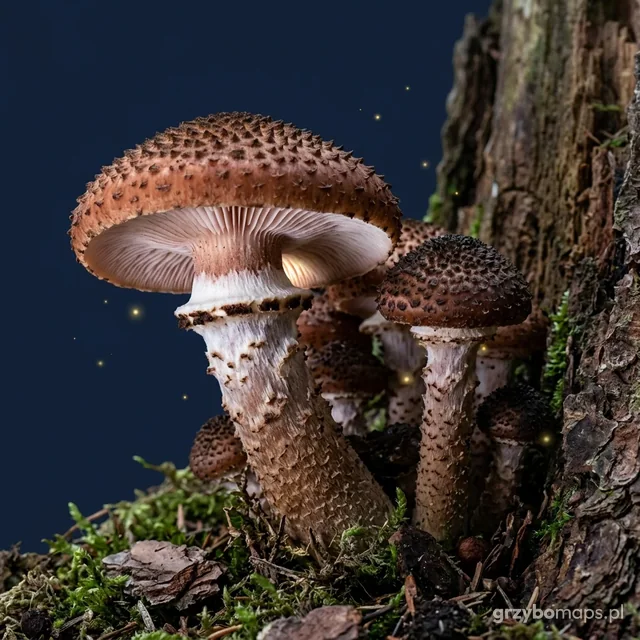
Dark honey fungus
Armillaria ostoyae
How to recognise
- Grows in clumps on stumps, roots and at the base of living trees, mainly coniferous.
- Cap rusty-brown to dark brown, densely covered with dark, protruding scales.
- Ring white, thick, with a dark brown edge on the underside.
- Gills whitish, brown-spotted with age; spore print white.
Up close
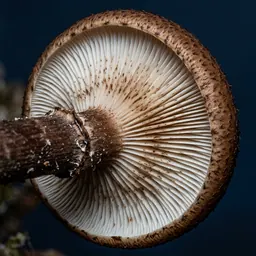 blaszki
Underside of the cap
Gills whitish, brown-spotted with age.
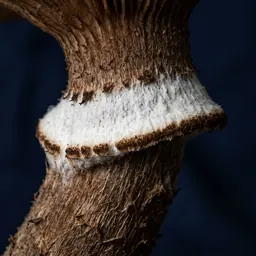 thick ring
Stem
Ring white, thick, with a dark brown edge on the underside.
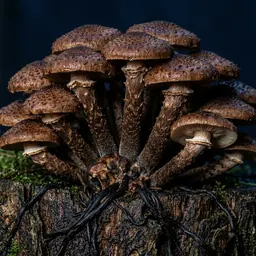 clumps on wood
Base of the stem
Grows in clumps on stumps, roots and at the base of trees.
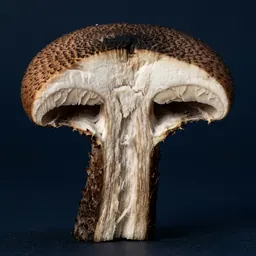 white flesh
Cross-section
Flesh whitish, stringy in the stem.
The close-ups are AI illustrations. Any doubt is settled by a mycologist or herbalist, not by a photo.
Where and when it grows
Very common in coniferous forests, less often in deciduous ones; a parasite and wood saprotroph. From August to November.
JanFebMarAprMayJunJulAugSepOctNovDec
Most often under: spruce, pine, fir (also broadleaved trees).
Beware of the lookalike
Sulphur tuft. The sulphur tuft has a sulphur-yellow, smooth cap, greenish-yellow gills, no membranous ring and a bitter taste. The honey fungus has dark scales on the cap, whitish gills and a distinct ring.
In the kitchen
Parboil young caps for about 5 minutes, discard the water, then keep cooking until tender and only then stew, fry or pickle.
Good to know
Edible only after parboiling (about 5 min) and pouring off the water – raw or undercooked it can cause gastrointestinal poisoning. Collect young caps.
Where in Poland
Most records in the GBIF database: wielkopolskie, łódzkie, pomorskie, zachodniopomorskie, warmińsko-mazurskie.
Recipes with this mushroom
Frequently asked questions
Is dark honey fungus edible?
Warunkowo. Edible only after parboiling (about 5 min) and pouring off the water – raw or undercooked it can cause gastrointestinal poisoning. Collect young caps.
When does dark honey fungus grow?
August – November. Very common in coniferous forests, less often in deciduous ones; a parasite and wood saprotroph. From August to November.
Dark honey fungus: what is it easily confused with?
Most often with the species Sulphur tuft. The sulphur tuft has a sulphur-yellow, smooth cap, greenish-yellow gills, no membranous ring and a bitter taste. The honey fungus has dark scales on the cap, whitish gills and a distinct ring.
Where in Poland does dark honey fungus grow?
Most records (GBIF): wielkopolskie, łódzkie, pomorskie, zachodniopomorskie, warmińsko-mazurskie. Most often under: spruce, pine, fir (also broadleaved trees).