

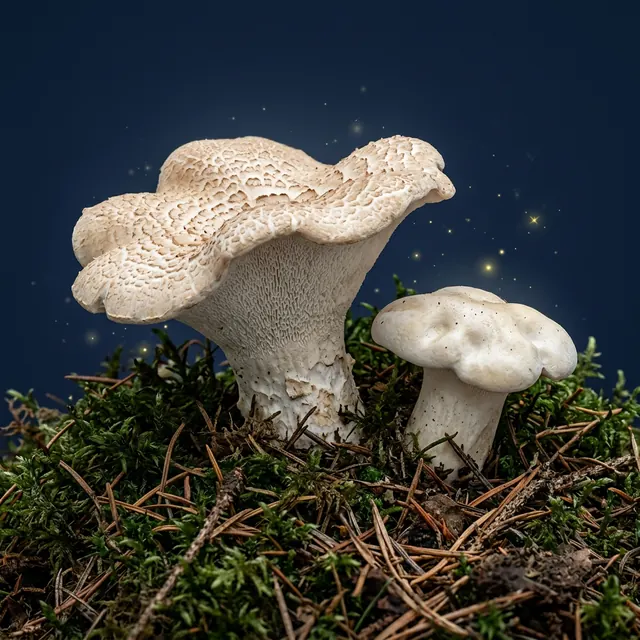
Sheep polypore
Albatrellus ovinus
Polish folk names: bielaczek owczy, huba owcza, żagiew owcza, sarna, pańscok
How to recognise
- Cap 5–12 cm, irregular, warped, whitish, greyish-yellow with age, ochre-brown to lemon-olive, cracked into small fields.
- Tubes whitish, then cream to yellow; pores very small (2–4 per mm), turning yellow when crushed.
- Stem 2–7 cm tall and 1–3 cm thick, smooth, whitish, often off-centre.
- Flesh white, then yellowish, fleshy; smell faintly almond, taste mild.
Up close
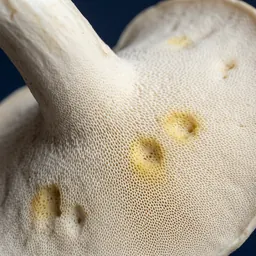 drobne pory
Underside of the cap
Very small, whitish to yellowish pores, running down the stem; turn yellow when pressed.
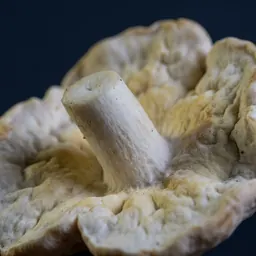 niecentralny
Stem
Short, smooth, whitish stem, often attached to the side.
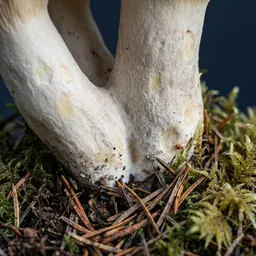 w koloniach
Base of the stem
Grows in groups on the ground in mountain spruce forests.
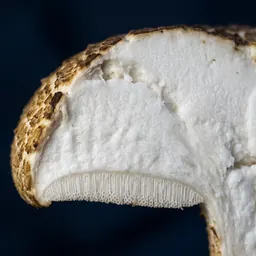 white flesh
Cross-section
Flesh white, fleshy, yellowish with age; smells faintly of almonds.
The close-ups are AI illustrations. Any doubt is settled by a mycologist or herbalist, not by a photo.
Where and when it grows
Coniferous forests, mainly in the mountains, under spruce, often on lime-rich soils, usually in colonies. From July to October. Rare in Poland, status E.
JanFebMarAprMayJunJulAugSepOctNovDec
Most often under: spruce, less often pine (mountains).
Beware of the lookalike
Albatrellopsis confluens. Naziemek ceglasty is apricot to brick-coloured, grows in fused clumps and has a slightly bitter taste.
In the kitchen
Edible after thorough cooking, but threatened with extinction in Poland – do not collect it. Leave it in the forest.
Good to know
According to some sources, when poorly cooked it can act as a laxative.
Frequently asked questions
Is sheep polypore edible?
Warunkowo. According to some sources, when poorly cooked it can act as a laxative.
When does sheep polypore grow?
July – October. Coniferous forests, mainly in the mountains, under spruce, often on lime-rich soils, usually in colonies. From July to October. Rare in Poland, status E.
Sheep polypore: what is it easily confused with?
Most often with the species Albatrellopsis confluens. Naziemek ceglasty is apricot to brick-coloured, grows in fused clumps and has a slightly bitter taste.