

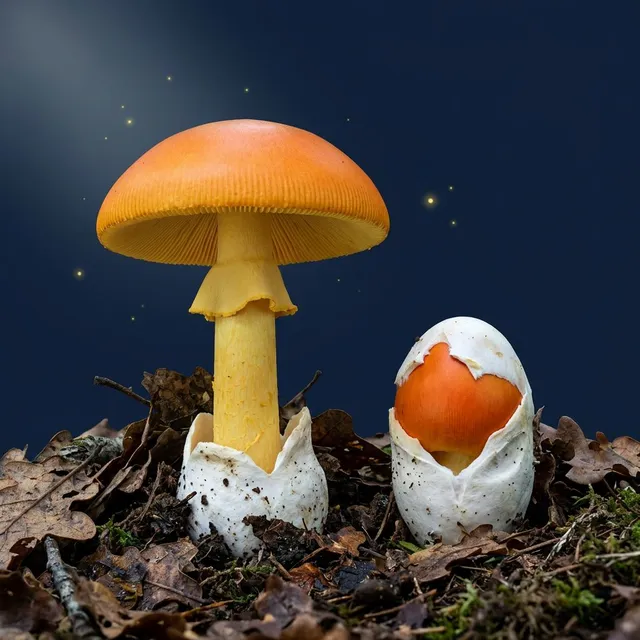
Caesar's mushroom
Amanita caesarea
Polish folk names: cesarski grzyb, muchomor cesarski
How to recognise
- Cap 8–20 cm, bright orange to orange-red, smooth, usually without spots.
- Gills free, crowded, golden yellow.
- Stem yellow with a yellow, hanging ring.
- At the base a large, loose, white volva, from which the mushroom emerges as if from an egg.
Where and when it grows
Warm oak and chestnut forests in southern Europe. There are no confirmed sites in Poland; the nearest it grows is in southern Czechia, Slovakia and Hungary, where it is rare and protected.
JanFebMarAprMayJunJulAugSepOctNovDec
Most often under: oak, sweet chestnut (southern Europe).
Beware of the lookalike
Fly agaric. The fly agaric has white gills and stem and white dots on the cap. Caesar's mushroom has yellow gills and stem, and a loose white volva at the base.
Feature-by-feature comparison: Caesar's mushroom or Fly agaric?
In the kitchen
It does not grow in Poland. In southern Europe it is eaten raw in salads and stewed, but only by experienced foragers.
Good to know
A famous delicacy of the ancient Romans. The young mushroom, still in its white covering, looks like an egg and is easy to confuse with a young, deadly poisonous amanita. That is why you should never pick amanitas at the “egg” stage.
Frequently asked questions
Is caesar's mushroom edible?
Yes, caesar's mushroom is an edible mushroom.
When does caesar's mushroom grow?
July – October. Warm oak and chestnut forests in southern Europe. There are no confirmed sites in Poland; the nearest it grows is in southern Czechia, Slovakia and Hungary, where it is rare and protected.
Caesar's mushroom: what is it easily confused with?
Most often with the species Fly agaric. The fly agaric has white gills and stem and white dots on the cap. Caesar's mushroom has yellow gills and stem, and a loose white volva at the base.