

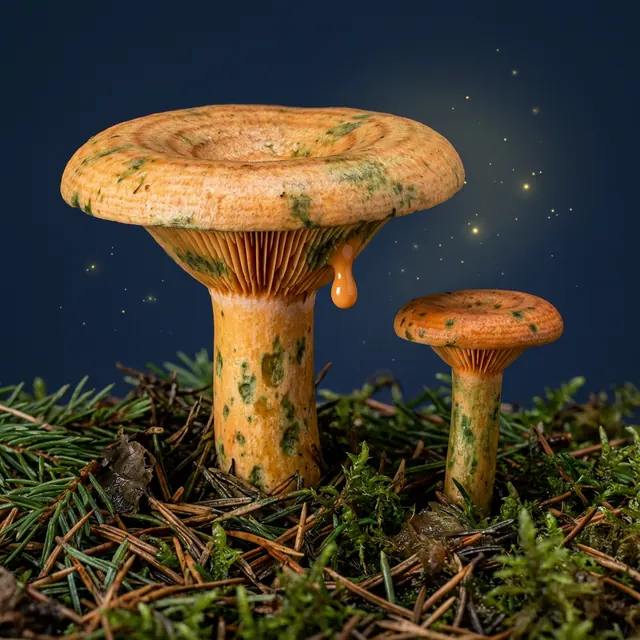
False saffron milkcap
Lactarius deterrimus
Polish folk names: mleczaj zmienny
How to recognise
- Cap 4–10 cm, reddish-orange, with faint darker zones, turns green after frosts.
- Gills red-orange, brittle, fairly crowded, turn green when damaged.
- Stem 3–7 cm tall and 1–2.5 cm thick, orange, green-spotted, quickly hollow, without pits.
- Milk orange, wine-red after about 15 minutes.
Where and when it grows
Coniferous and mixed forests, exclusively under spruces, often in masses in young spruce stands; more common in the mountains. From August to October.
JanFebMarAprMayJunJulAugSepOctNovDec
Most often under: spruce (exclusively).
Beware of the lookalike
Saffron milk cap. The saffron milk cap grows under pines, has more distinct zones on the cap and turns green only when damaged. Both are edible.
Feature-by-feature comparison: False saffron milkcap or Saffron milk cap?
In the kitchen
Edible, but inferior to the saffron milk cap, with a slightly bitter aftertaste. Fry briefly or pickle in vinegar or oil; do not freeze or dry.
Frequently asked questions
Is false saffron milkcap edible?
Yes, false saffron milkcap is an edible mushroom.
When does false saffron milkcap grow?
August – October. Coniferous and mixed forests, exclusively under spruces, often in masses in young spruce stands; more common in the mountains. From August to October.
False saffron milkcap: what is it easily confused with?
Most often with the species Saffron milk cap. The saffron milk cap grows under pines, has more distinct zones on the cap and turns green only when damaged. Both are edible.