


Weeping milk cap
Lactifluus volemus
Polish folk names: mleczaj smaczny, rydz smaczny, krówka, mleczarka
How to recognise
- Cap 5–12 cm, orange-brown to reddish-brown, matt, as if suede-like.
- When injured it exudes very abundant white milk with a mild taste; as it dries it turns brown.
- Gills cream, dense, turning brown when pressed; stem the colour of the cap, solid.
- Older fruiting bodies smell of fish (herring).
Up close
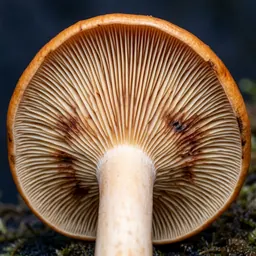 blaszki
Underside of the cap
Gills cream, dense, turning brown when pressed.
 solid
Stem
Stem the colour of the cap, solid.
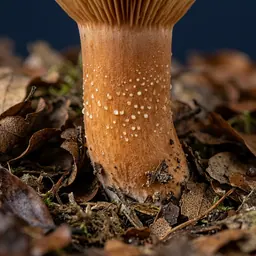 bez pochwy
Base of the stem
Base without a volva.
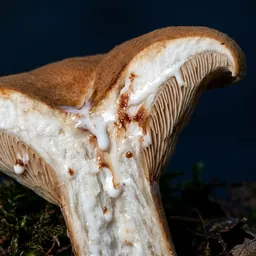 mleczko
Cross-section
Abundant white milk; it turns brown as it dries. Older ones smell of fish.
The close-ups are AI illustrations. Any doubt is settled by a mycologist or herbalist, not by a photo.
Where and when it grows
Deciduous and mixed forests, often under beeches, oaks and hazel, less often under spruces; from July to October.
JanFebMarAprMayJunJulAugSepOctNovDec
Most often under: beech, oak, hazel, spruce.
Beware of the lookalike
Rufous milkcap (Lactarius rufus). The rufous milkcap is brick-red with a small umbo in the centre, and after a moment its milk burns strongly. The weeping milk cap has plentiful, mild milk and a distinct smell of herring.
In the kitchen
Best fried over medium heat like the saffron milk cap; the fishy smell disappears during frying. Pick it carefully so that it does not lose its milk.
Where in Poland
Most records in the GBIF database: wielkopolskie, zachodniopomorskie, małopolskie, pomorskie, śląskie.
Frequently asked questions
Is weeping milk cap edible?
Yes, weeping milk cap is an edible mushroom.
When does weeping milk cap grow?
July – October. Deciduous and mixed forests, often under beeches, oaks and hazel, less often under spruces; from July to October.
Weeping milk cap: what is it easily confused with?
Most often with the species Rufous milkcap (Lactarius rufus). The rufous milkcap is brick-red with a small umbo in the centre, and after a moment its milk burns strongly. The weeping milk cap has plentiful, mild milk and a distinct smell of herring.
Where in Poland does weeping milk cap grow?
Most records (GBIF): wielkopolskie, zachodniopomorskie, małopolskie, pomorskie, śląskie. Most often under: beech, oak, hazel, spruce.