

Horn of plenty
Craterellus cornucopioides
Polish folk names: trąbka umarłych, trąbka śmierci, kominki, wroniaki
How to recognise
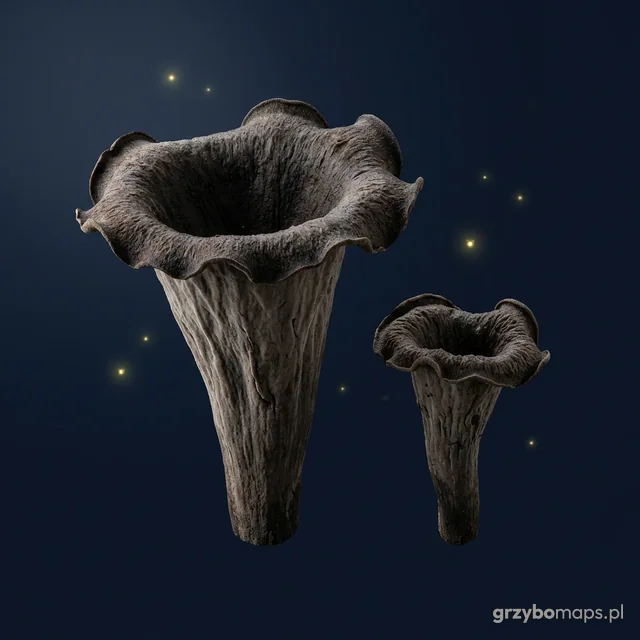
- Fruiting body trumpet- or funnel-shaped, black, dark grey or brownish.
- Hollow right down to the base, edge wavy, often rolled outwards.
- Underside smooth or slightly wrinkled, ash-grey – no gills.
- Grows in clumps among leaves; because of its dark colour it is very hard to spot.
Up close
 bez blaszek
Outer surface
Underside smooth or slightly wrinkled, ash-grey – no gills.
 trumpet
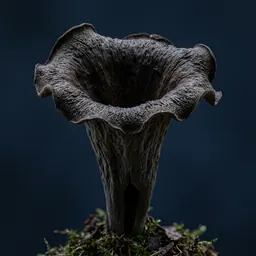
Shape
Fruiting body trumpet- or funnel-shaped, black or dark grey.
 in leaves
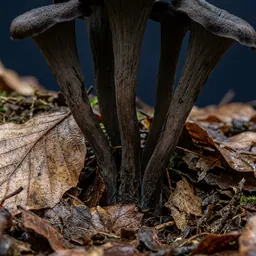
Base
Grows in clumps among leaves, very hard to spot.
 pusty
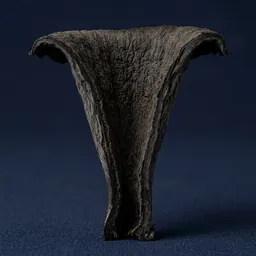
Cross-section
Hollow in the middle right down to the base, thin walls.
The close-ups are AI illustrations. Any doubt is settled by a mycologist or herbalist, not by a photo.
Where and when it grows
Deciduous and mixed forests, most often under beeches and oaks, usually in clumps in foothill areas. From August to November.
JanFebMarAprMayJunJulAugSepOctNovDec
Most often under: beech, oak.
Beware of the lookalike
Ashen chanterelle. The ashen chanterelle (Craterellus cinereus) has distinct, forked ridges and a solid stem; it is harmless too.
In the kitchen
Best dried and ground as a seasoning for soups and sauces; fresh, it can be stewed or added to scrambled eggs (it darkens when cooked).
Good to know
A species becoming ever rarer – collect in moderation, only single clumps.
Where in Poland
Most records in the GBIF database: pomorskie, małopolskie, wielkopolskie, mazowieckie, zachodniopomorskie.
Frequently asked questions
Is horn of plenty edible?
Yes, horn of plenty is an edible mushroom.
When does horn of plenty grow?
August – November. Deciduous and mixed forests, most often under beeches and oaks, usually in clumps in foothill areas. From August to November.
Horn of plenty: what is it easily confused with?
Most often with the species Ashen chanterelle. The ashen chanterelle (Craterellus cinereus) has distinct, forked ridges and a solid stem; it is harmless too.
Where in Poland does horn of plenty grow?
Most records (GBIF): pomorskie, małopolskie, wielkopolskie, mazowieckie, zachodniopomorskie. Most often under: beech, oak.