

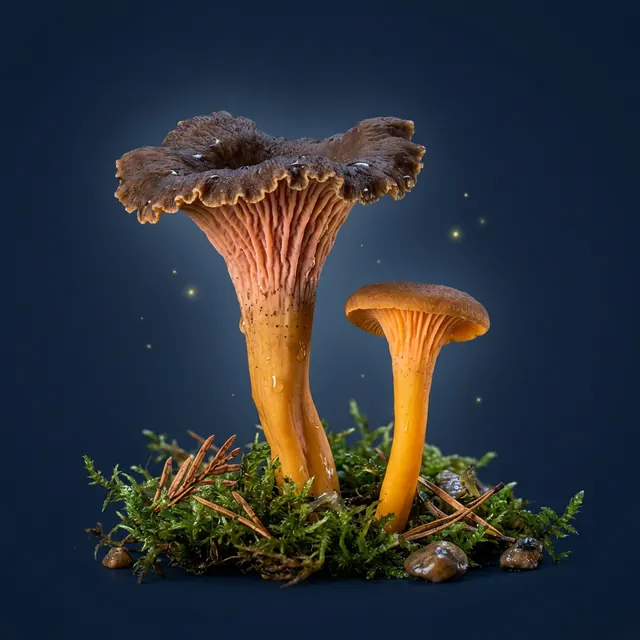
Craterellus lutescens
Craterellus lutescens
Polish folk names: pieprznik żółtawy, pieprznik żyłkowany
How to recognise
- Cap 2–8 cm, deeply funnel-shaped, with a lobed, ragged margin, ochre-brown to dark brown.
- Underside smooth in young ones, then wrinkled, with sparse running-down veins; yellow-orange, never blackish-grey.
- Stem 5–8 cm tall and 0.4–1.5 cm thick, hollow, often flattened, bright yellow to orange.
- Flesh thin, whitish, with a fruity smell (mirabelle plums) and a pleasant taste.
Up close
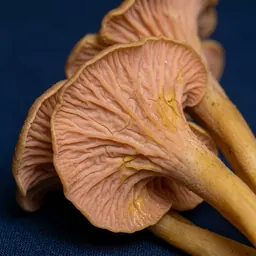 almost smooth
Underside of the cap
Underside pinkish-yellow to yellow-orange, smooth or wrinkled, with shallow veins instead of gills.
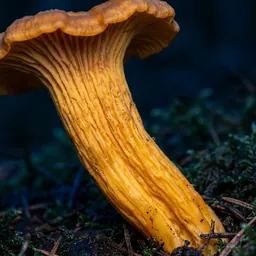 golden stem
Stem
Stem bright yellow to orange, often flattened and grooved.
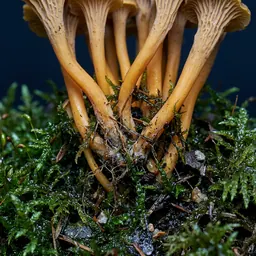 w mchu
Base of the stem
Grows in clumps in wet moss, by streams.
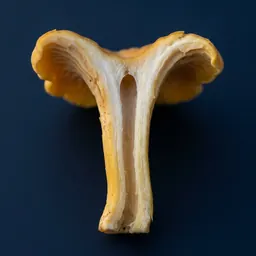 hollow inside
Cross-section
The whole fruiting body is hollow like a tube: the channel runs from the funnel to the base.
The close-ups are AI illustrations. Any doubt is settled by a mycologist or herbalist, not by a photo.
Where and when it grows
Forests, especially in the foothills and mountains, in damp, shady places by streams and in mosses, also on peat bogs. Rare in Poland (status R).
JanFebMarAprMayJunJulAugSepOctNovDec
Most often under: spruce, fir, beech, pine (damp mosses).
Beware of the lookalike
Winter chanterelle. The yellowfoot has a grey underside with distinct veins and a more grey-yellow stem. Brzoskwiniowonny has an almost smooth, yellow-orange underside. Both are edible.
In the kitchen
Edible and aromatic, but rare in Poland. If you do collect it, take sparingly and fry briefly in butter (10 minutes) or dry it.
Frequently asked questions
Is craterellus lutescens edible?
Yes, craterellus lutescens is an edible mushroom.
When does craterellus lutescens grow?
August – November. Forests, especially in the foothills and mountains, in damp, shady places by streams and in mosses, also on peat bogs. Rare in Poland (status R).
Craterellus lutescens: what is it easily confused with?
Most often with the species Winter chanterelle. The yellowfoot has a grey underside with distinct veins and a more grey-yellow stem. Brzoskwiniowonny has an almost smooth, yellow-orange underside. Both are edible.