

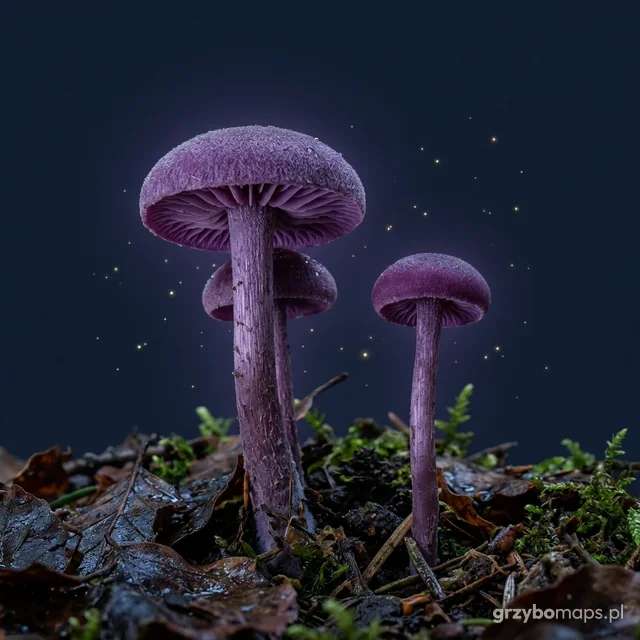
Amethyst deceiver
Laccaria amethystina
Polish folk names: bedłka fioletowa
How to recognise
- Cap 2–6 cm, thin, intensely violet, fading to greyish-white in dry weather (hygrophanous).
- Gills distant, thick, violet, as if dusted with white powder.
- Stem thin, violet, fibrous and tough, without a ring.
- Spore print white.
Up close
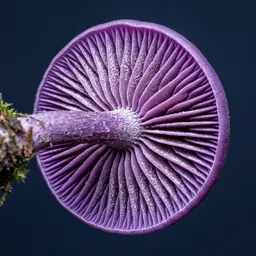 rzadkie blaszki
Underside of the cap
Gills sparse, thick, violet, as if dusted.
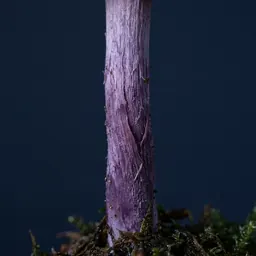 fibrous
Stem
Stem thin, violet, fibrous and tough, without a ring.
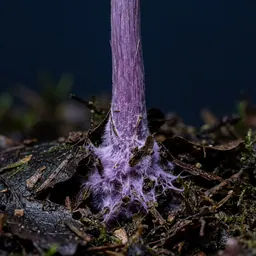 liliowa grzybnia
Base of the stem
Base with a lilac felt of mycelium, without a volva.
 fioletowy
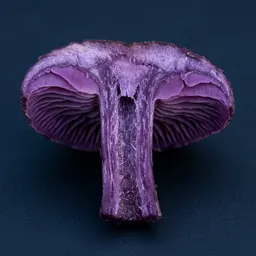
Cross-section
Flesh thin, violet-tinged, without a distinct smell.
The close-ups are AI illustrations. Any doubt is settled by a mycologist or herbalist, not by a photo.
Where and when it grows
Very common in deciduous (especially beech) and coniferous forests, in leaf litter and moss; from July to November.
JanFebMarAprMayJunJulAugSepOctNovDec
Most often under: beech, oak, spruce, pine.
Beware of the lookalike
Lilac fibrecap (Inocybe lilacina). The fibrecap has a cap with an umbo, fibrous, denser gills that turn brown from the spores, and a rusty-brown spore print. The amethyst deceiver has sparse, thick violet gills and a white spore print.
Feature-by-feature comparison: Amethyst deceiver or Lilac bonnet?
In the kitchen
Use only the caps, as an addition to a mushroom mix; it loses its colour after cooking, the stems are fibrous.
Good to know
Edible, but small and of little value. It strongly accumulates arsenic from the soil – eat it rarely, in small amounts, and never from contaminated areas. It is easily confused with the poisonous violet fibrecaps and bonnets.
Where in Poland
Most records in the GBIF database: zachodniopomorskie, wielkopolskie, śląskie, małopolskie, pomorskie.
Frequently asked questions
Is amethyst deceiver edible?
Warunkowo. Edible, but small and of little value. It strongly accumulates arsenic from the soil – eat it rarely, in small amounts, and never from contaminated areas. It is easily confused with the poisonous violet fibrecaps and bonnets.
When does amethyst deceiver grow?
July – November. Very common in deciduous (especially beech) and coniferous forests, in leaf litter and moss; from July to November.
Amethyst deceiver: what is it easily confused with?
Most often with the species Lilac fibrecap (Inocybe lilacina). The fibrecap has a cap with an umbo, fibrous, denser gills that turn brown from the spores, and a rusty-brown spore print. The amethyst deceiver has sparse, thick violet gills and a white spore print.
Where in Poland does amethyst deceiver grow?
Most records (GBIF): zachodniopomorskie, wielkopolskie, śląskie, małopolskie, pomorskie. Most often under: beech, oak, spruce, pine.