

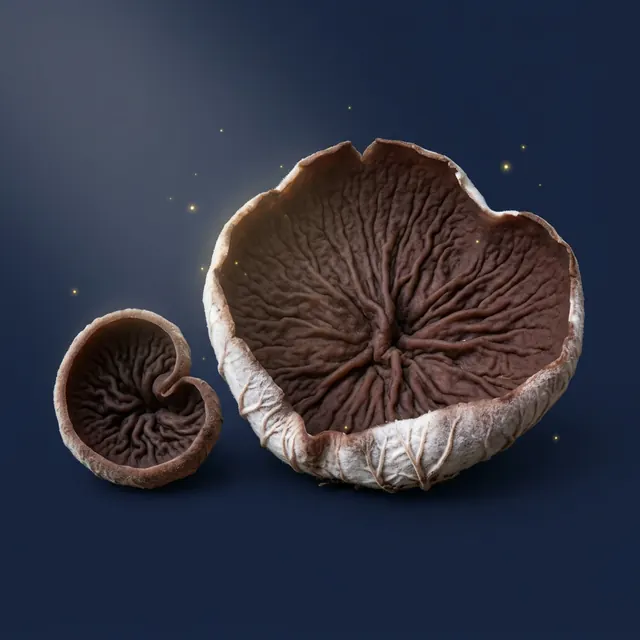
Bleach cup
Disciotis venosa
Strictly protected species
How to recognise
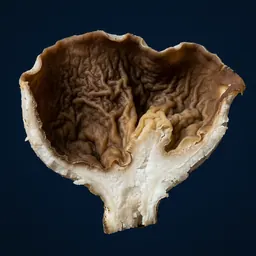
- Fruiting body 5–15 cm, cup-shaped and irregular, spread flat in older specimens.
- Inside grey-brown, yellow-brown to dark red-brown, delicately wrinkled.
- Outer side whitish, mealy-downy, veined towards the base; stem short, poorly defined.
- Flesh brittle, whitish, with a distinct smell of chlorine.
Up close
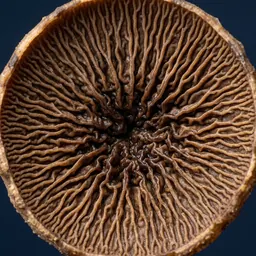 pomarszczone
Inside of the cup
Interior greyish-brown to reddish-brown, folded and wrinkled like veins.
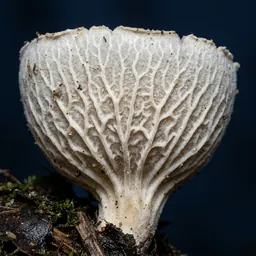 whitish, mossy
Outer side
Underside of the cup whitish, mossy, with distinct veins at the base.
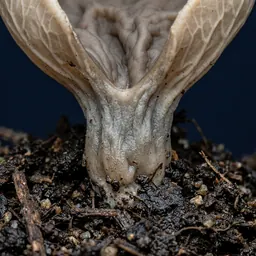 short stem
Attachment
A short, pale grey, weakly defined stem embedded in the ground.
 zapach chloru
Cross-section
Flesh brittle, whitish, with a distinct smell of chlorine.
The close-ups are AI illustrations. Any doubt is settled by a mycologist or herbalist, not by a photo.
Where and when it grows
On the ground in deciduous forests and parks, preferably on limestone soil. In April and May; rare in Poland.
JanFebMarAprMayJunJulAugSepOctNovDec
Most often under: deciduous forests, parks, calcareous soils.
Beware of the lookalike
Krążkownica wrębiasta. Krążkownica wrębiasta grows on rotting wood in coniferous forests, is smaller and does not smell of chlorine.
In the kitchen
A strictly protected species – it is forbidden to collect or destroy it. Leave it in the forest and take a photo of it.
Good to know
On the Red List of Fungi of Poland it has the status R. Protected since 1983.
Frequently asked questions
Is bleach cup edible?
Yes, bleach cup is an edible mushroom.
When does bleach cup grow?
April – May. On the ground in deciduous forests and parks, preferably on limestone soil. In April and May; rare in Poland.
Bleach cup: what is it easily confused with?
Most often with the species Krążkownica wrębiasta. Krążkownica wrębiasta grows on rotting wood in coniferous forests, is smaller and does not smell of chlorine.