

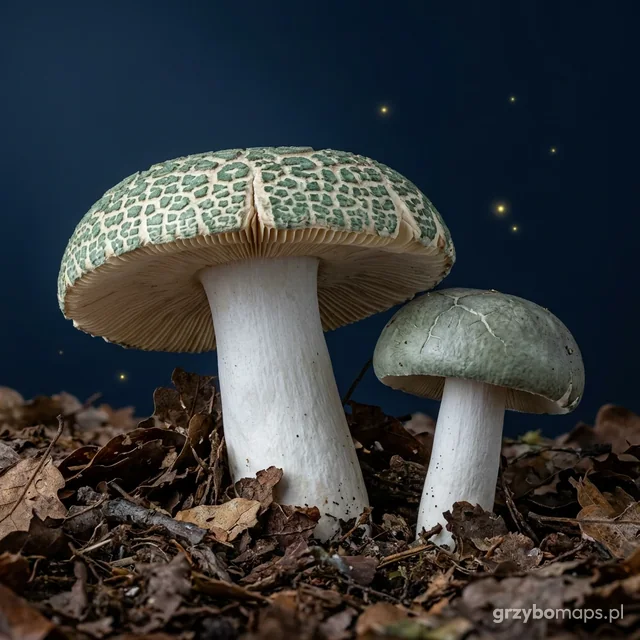
Greenish brittlegill
Russula virescens
Polish folk names: surowiatka, siwek, gołąbek zielony
How to recognise
- Cap grey-green or olive-green, matt, cracking with age into a characteristic mosaic of small fields.
- Gills white to cream, brittle, snapping like chalk.
- Stem white, rigid, without a ring and without a volva at the base.
- Flesh white, taste mild, nutty.
Up close
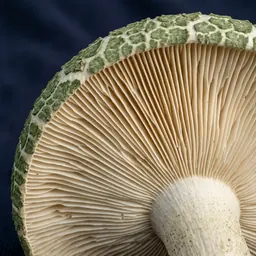 kruche blaszki
Underside of the cap
Gills white to cream, brittle as chalk.
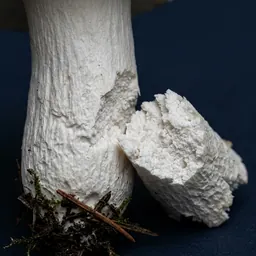 no ring
Stem
Stem white, rigid, without a ring.
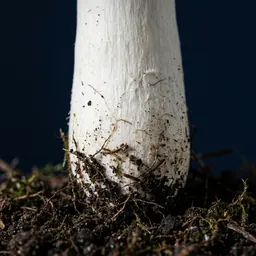 no volva
Base of the stem
Base without a volva and bulb – this tells it apart from the Death cap (Amanita phalloides).
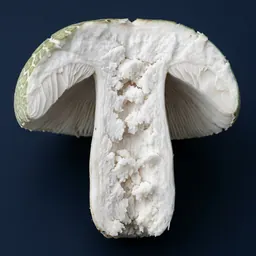 kruchy
Cross-section
Flesh white, brittle, snaps like chalk, not fibrously.
The close-ups are AI illustrations. Any doubt is settled by a mycologist or herbalist, not by a photo.
Where and when it grows
Deciduous and mixed forests, most often under oaks, beeches and birches; from June to October.
JanFebMarAprMayJunJulAugSepOctNovDec
Most often under: oak, beech, birch.
Beware of the lookalike
Death cap. An amanita has a smooth cap, a ring on the stem and a bulb in a sheath at the base. A brittlegill has neither ring nor sheath, and the skin of its cap cracks into patches with age.
Feature-by-feature comparison: Greenish brittlegill or Death cap?
In the kitchen
Tasty fried or stewed, good for soups and sauces; regarded as one of the tastiest brittlegills.
Good to know
Young specimens with a smooth cap are easily confused with the deadly poisonous death cap – always dig up the whole stem and check the base.
Where in Poland
Most records in the GBIF database: wielkopolskie, lubelskie, łódzkie, podlaskie, pomorskie.
Frequently asked questions
Is greenish brittlegill edible?
Yes, greenish brittlegill is an edible mushroom.
When does greenish brittlegill grow?
June – October. Deciduous and mixed forests, most often under oaks, beeches and birches; from June to October.
Greenish brittlegill: what is it easily confused with?
Most often with the species Death cap. An amanita has a smooth cap, a ring on the stem and a bulb in a sheath at the base. A brittlegill has neither ring nor sheath, and the skin of its cap cracks into patches with age.
Where in Poland does greenish brittlegill grow?
Most records (GBIF): wielkopolskie, lubelskie, łódzkie, podlaskie, pomorskie. Most often under: oak, beech, birch.