

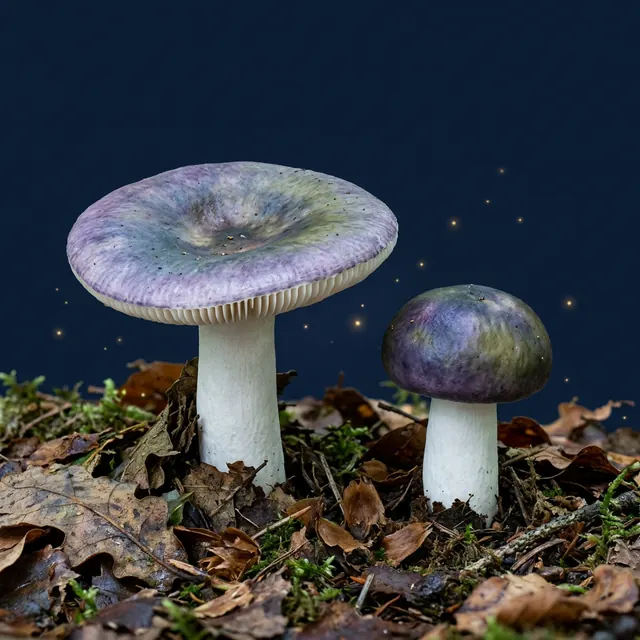
Charcoal burner
Russula cyanoxantha
Polish folk names: gołąbek modrożółty, gołąbek fioletowy, gołąbek zielony, serowiatka zielonawa, zielonka
How to recognise
- Cap 5–15 cm, violet, blue, pink, ochre or olive, often multicoloured; concave when old.
- Gills white, fairly crowded, flexible and elastic – they do not crumble when touched.
- Stem 5–12 cm tall and 2–3 cm thick, white, rarely tinged lilac.
- Flesh permanently white, taste mild; spore print white.
Where and when it grows
Mainly deciduous forests under oaks and beeches, less often coniferous; avoids calcareous soils. From July to October; very common in Poland.
JanFebMarAprMayJunJulAugSepOctNovDec
Most often under: oak, beech; less often conifers.
Beware of the lookalike
Death cap. The amanita has a ring on the stem and a bulb in a volva at the base. The charcoal burner has neither a ring nor a volva, and its stem is brittle and white.
In the kitchen
One of the tastiest russulas, with crunchy flesh. Fry, stew or pickle in vinegar, always after heat treatment.
Frequently asked questions
Is charcoal burner edible?
Yes, charcoal burner is an edible mushroom.
When does charcoal burner grow?
July – October. Mainly deciduous forests under oaks and beeches, less often coniferous; avoids calcareous soils. From July to October; very common in Poland.
Charcoal burner: what is it easily confused with?
Most often with the species Death cap. The amanita has a ring on the stem and a bulb in a volva at the base. The charcoal burner has neither a ring nor a volva, and its stem is brittle and white.