

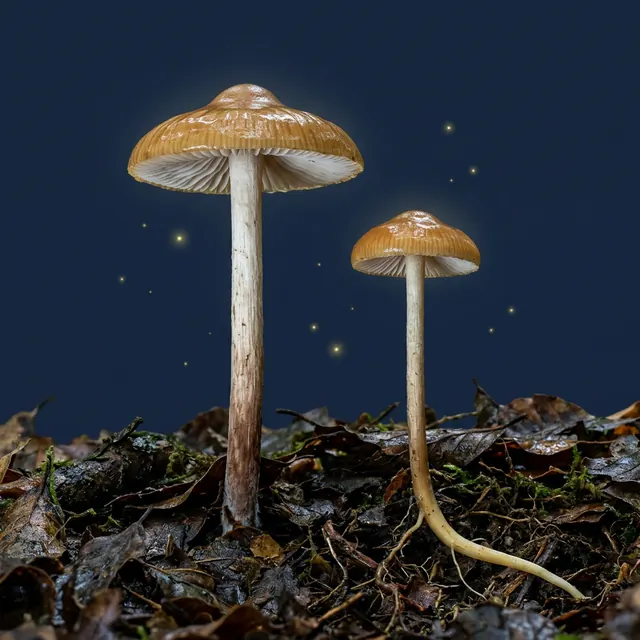
Rooting shank
Hymenopellis radicata
Polish folk names: pieniążkówka korzeniasta, pieniążkówka gładkotrzonowa, monetka korzeniasta
How to recognise
- Cap 4–12 cm, with a blunt umbo, shiny and sticky when wet, often characteristically wrinkled; ochre to yellow-brown.
- Gills distant, white, of different lengths.
- Stem 10–20 cm tall and 5–12 mm thick, whitish, brownish below.
- Underground, a root-like extension of the stem, up to 30 cm long.
Up close
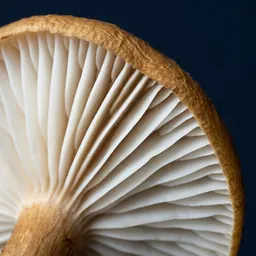 distant, white
Underside of the cap
Gills distant, broad, white, of different lengths, rounded at the stem.
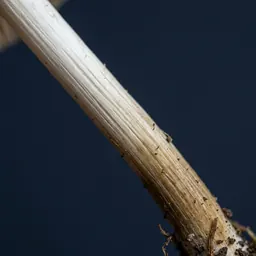 very long
Stem
Stem 10–20 cm, stiff, whitish, brownish at the bottom, finely grooved lengthwise.
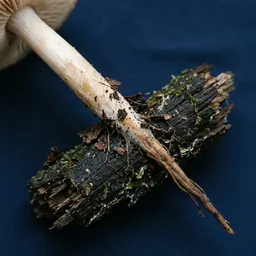 long root
Base of the stem
The stem continues into a thin, root-like extension up to 30 cm, reaching down to buried wood.
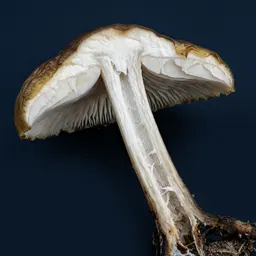 white flesh
Cross-section
Flesh white, brittle, does not change colour; older stem tubular.
The close-ups are AI illustrations. Any doubt is settled by a mycologist or herbalist, not by a photo.
Where and when it grows
Deciduous and mixed forests, parks, roadsides; on rotting roots and buried wood, especially of beech, oak, hornbeam and aspen. From June to November; common.
JanFebMarAprMayJunJulAugSepOctNovDec
Most often under: beech, oak, hornbeam, aspen (buried roots).
Beware of the lookalike
Pieniążkówka dębowa. Pieniążkówka dębowa has a dark brown stem, a suede-like, dry cap and a bitter taste.
In the kitchen
Eat only the caps, because the stem is fibrous. Add to a mixed stew or soup, cooking for at least 20 minutes; the cap skin peels off easily.
Frequently asked questions
Is rooting shank edible?
Yes, rooting shank is an edible mushroom.
When does rooting shank grow?
June – November. Deciduous and mixed forests, parks, roadsides; on rotting roots and buried wood, especially of beech, oak, hornbeam and aspen. From June to November; common.
Rooting shank: what is it easily confused with?
Most often with the species Pieniążkówka dębowa. Pieniążkówka dębowa has a dark brown stem, a suede-like, dry cap and a bitter taste.