

Japanese knotweed
Reynoutria japonica Houtt. (syn. Fallopia japonica (Houtt.) Ronse Decr.)
Polish folk names: rdestowiec japoński, rdest japoński, hu zhang
Traditional use
Young spring shoots up to about 20 cm are edible: sour like rhubarb, good for compotes, jams and cakes. In traditional Chinese medicine the rhizome, called hu zhang, was used for joint pain and inflammation. Today the knotweed rhizome is the main source of resveratrol for dietary supplements. The effectiveness of these uses in humans is not well confirmed.
What it looks like
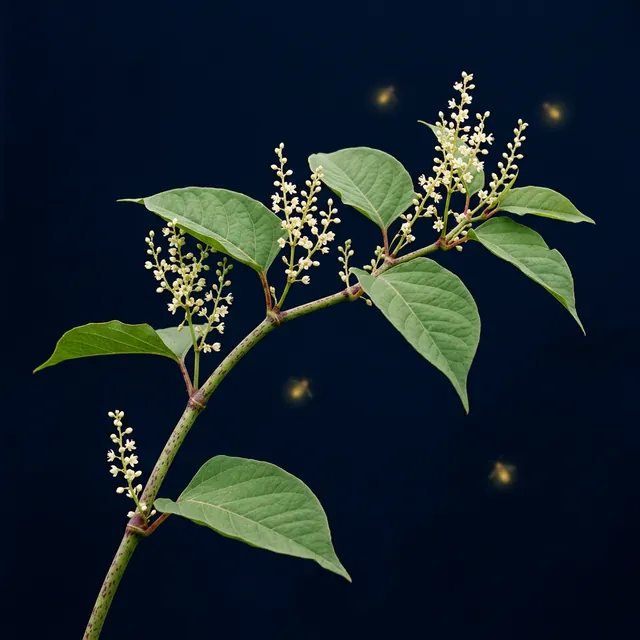
A perennial 1–3 m tall forming dense stands. Stems hollow, jointed like bamboo, green with red spots. Leaves broad, ovate, cut straight across at the base, with a pointed tip, up to 15 cm. Small creamy-white flowers in panicles in the leaf axils in August–September. In winter, dry brown canes remain.
Harvest
Gathered: young shoots, rhizome.
When: April – May.
Form: young shoots cooked like rhubarb, rhizome in traditional Chinese medicine.
Lookalikes
- giant knotweed (Reynoutria sachalinensis) – larger, up to 4 m, leaves up to 40 cm, heart-shaped at the base; also invasive and also with edible young shoots
- Russian vine (Aubert's knotweed) – a thin, twining climber with white flowers, also invasive
The information is educational and describes traditional use according to EMA/HMPC monographs (the European Medicines Agency and its Committee on Herbal Medicinal Products).It does not replace the advice of a doctor or pharmacist. Never eat a plant you are not 100% sure you recognise.