

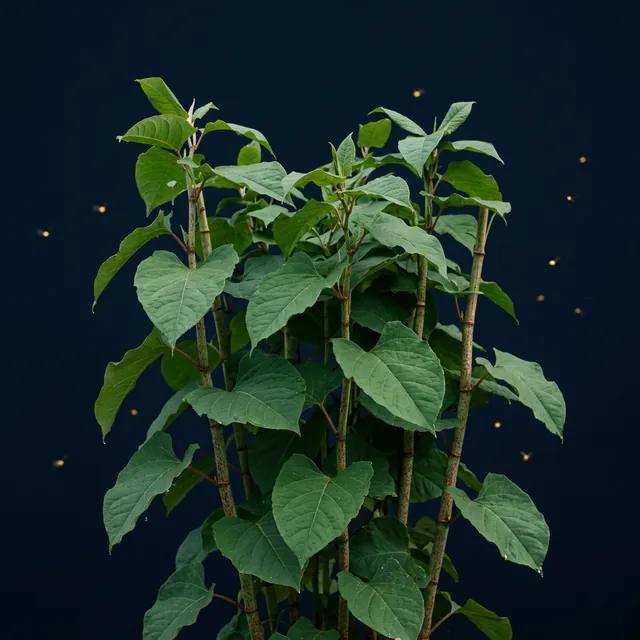
Giant knotweed
Reynoutria sachalinensis (F. Schmidt) Nakai (syn. Fallopia sachalinensis)
Polish folk names: rdestowiec Sachalina, rdest sachaliński
Traditional use
This is one of the most dangerous invasive species. It smothers native plants and destroys riverbanks. Young shoots are edible after heat treatment, as with Japanese knotweed, but they contain oxalic acid.
What it looks like
Perennial up to 4 m, forming dense, uniform stands. Stems green or reddish, thick, hollow, with swellings at the nodes. Leaves very large (up to 40 cm), ovate with a heart-shaped base, hairy underneath. Small cream flowers in the leaf axils, in August and September.
Harvest
Gathered: young shoots.
When: April – May.
Form: jam, zupy, salads (after cooking).
Lookalikes
- Japanese knotweed – smaller leaves, ovate with a pointed tip and a flat, truncated base; Sakhalin knotweed has leaves up to 40 cm with a heart-shaped base
- Bohemian knotweed – an intermediate form, leaves with features of both species
The information is educational and describes traditional use according to EMA/HMPC monographs (the European Medicines Agency and its Committee on Herbal Medicinal Products).It does not replace the advice of a doctor or pharmacist. Never eat a plant you are not 100% sure you recognise.