

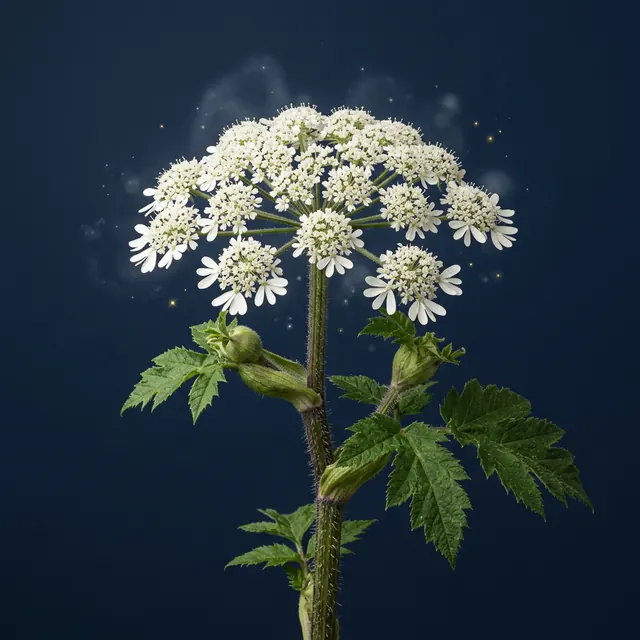
Common hogweed
Heracleum sphondylium L.
Polish folk names: barszcz
Symptoms of poisoning
Phytophotodermatitis: after skin contact with the sap and exposure to the sun, redness, burn-like blisters, then long-lasting discolouration. In sensitive people the reaction is weaker than after Sosnowsky’s hogweed, but possible.
What it looks like
Perennial of meadows and roadsides, 50–150 cm, with a strong smell. Stem hollow, angular and furrowed, roughly hairy. Leaves rough, pinnate or 3-lobed, with 3–5-lobed leaflets; upper ones with a large sheath. White, sometimes pinkish flowers in umbels of 15–30 umbellets; the marginal flowers have larger petals. Fruits flat, elliptic, 6–10 mm.
What it is sometimes confused with
- Sosnowsky's hogweed and giant hogweed (young plants – much more dangerous)
- poison hemlock, cowbane (water hemlock), water-dropwort (white umbels – very poisonous)
- angelica and other edible umbellifers
The information is educational and describes traditional use according to EMA/HMPC monographs (the European Medicines Agency and its Committee on Herbal Medicinal Products).It does not replace the advice of a doctor or pharmacist. Never eat a plant you are not 100% sure you recognise.