

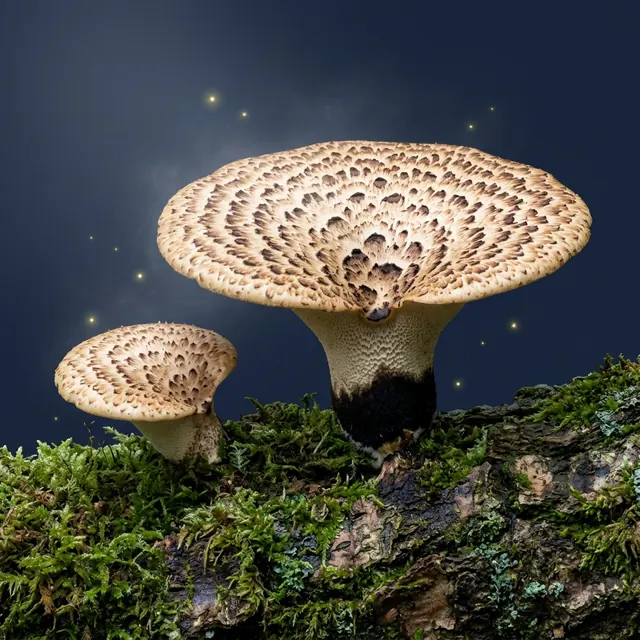
Dryad's saddle
Cerioporus squamosus (syn. Polyporus squamosus)
Polish folk names: żagiew łuskowata, huba łuskowata, horosz szupinowaty, huba wielka
How to recognise
- Cap 10–40 cm, semicircular to fan-shaped, cream with dark brown scales arranged concentrically.
- Pores white or cream, angular, large (1–2.5 mm), running down the stem.
- Stem lateral, short and stout, whitish at the top, covered with blackish-brown down at the bottom.
- Flesh white, juicy, smelling of flour or cucumber; hardens with age and becomes corky.
Up close
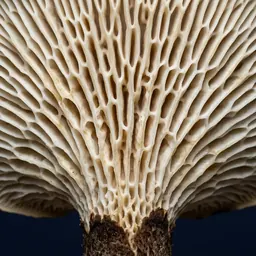 large pores
Underside of the cap
White or cream, angular pores 1–2.5 mm wide, running down the stem.
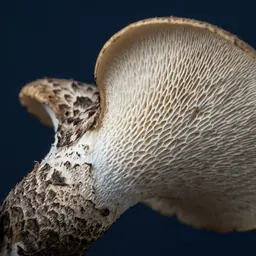 lateral, short
Stem
Short, stocky stem growing from the side of the cap, white at the top.
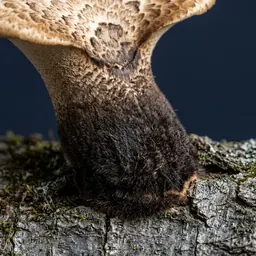 czarny kutner
Base of the stem
The lower part of the stem is covered with a brownish-black or black, velvety down.
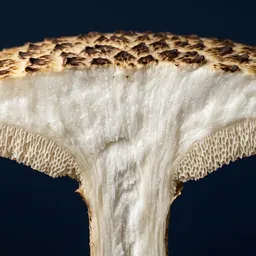 white flesh
Cross-section
Flesh white, juicy, does not change colour; smell mealy or cucumber-like.
The close-ups are AI illustrations. Any doubt is settled by a mycologist or herbalist, not by a photo.
Where and when it grows
A parasite of living and dying deciduous trees, most often beech, maple and ash, in forests, parks and by roads. Young fruiting bodies from March until the first frosts.
JanFebMarAprMayJunJulAugSepOctNovDec
Most often under: beech, maple, ash, elm, linden, poplar (living and dying trunks).
Beware of the lookalike
Żagiew guzowata. Żagiew guzowata is much smaller (up to 15 cm), has a funnel-shaped cap and a central stem.
In the kitchen
Young, soft fruiting bodies only. Parboil first, then cut into thin strips and stew or fry; do not collect old, tough ones.
Good to know
Only young, soft fruiting bodies are edible; older ones quickly harden and become stringy.
Frequently asked questions
Is dryad's saddle edible?
Warunkowo. Only young, soft fruiting bodies are edible; older ones quickly harden and become stringy.
When does dryad's saddle grow?
March – November. A parasite of living and dying deciduous trees, most often beech, maple and ash, in forests, parks and by roads. Young fruiting bodies from March until the first frosts.
Dryad's saddle: what is it easily confused with?
Most often with the species Żagiew guzowata. Żagiew guzowata is much smaller (up to 15 cm), has a funnel-shaped cap and a central stem.