

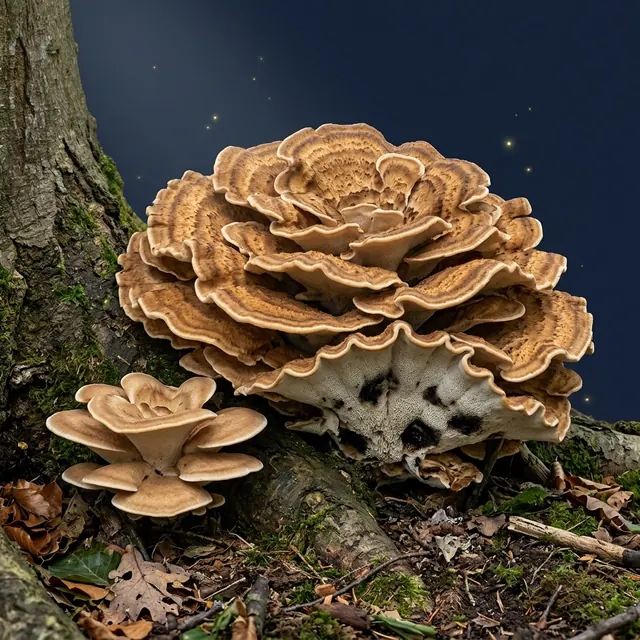
Giant polypore
Meripilus giganteus
Polish folk names: żagiew olbrzymia, flagowiec olbrzymi
How to recognise
- Fruiting body annual, 30–80 cm, made up of many overlapping, fan-shaped caps on a common base.
- Caps yellow-brown, then chestnut, concentrically banded, with tiny scales and a paler, cream margin.
- Tubes short, whitish, pores very small (about 0.3 mm); turn brown when damaged, then black.
- Flesh white, fibrous, turning black in cross-section; strongly mushroomy smell, sourish taste.
Up close
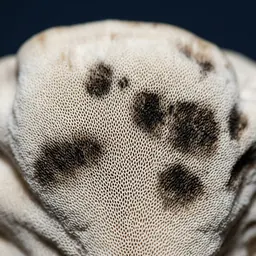 pores turn black
Underside of the cap
Whitish, very small pores; they turn brown when touched, and then black.
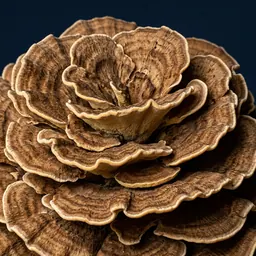 wielka rozeta
Shape
A rosette of 30–80 cm made of many large, fan-shaped, brown caps.
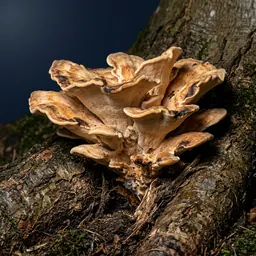 u podstawy pnia
Base
Grows from a common base at the foot of a trunk or from roots near a stump.
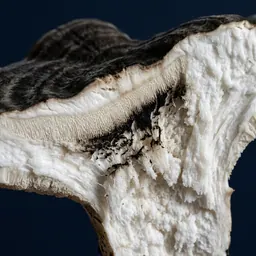 czernieje
Cross-section
Flesh white, fibrous, turns black when cut.
The close-ups are AI illustrations. Any doubt is settled by a mycologist or herbalist, not by a photo.
Where and when it grows
At the base of trunks and by stumps of deciduous trees, especially beech and oak, exceptionally coniferous; most often in parks and by roadside trees. In autumn; after frosts it collapses into a black mass.
JanFebMarAprMayJunJulAugSepOctNovDec
Most often under: beech, oak and other deciduous trees (at the base of trunks, by stumps).
Beware of the lookalike
Hen of the woods. The hen of the woods has dozens of small, grey-brown caps and does not turn black when damaged. The giant polypore has large, brown caps that turn black.
Feature-by-feature comparison: Giant polypore or Hen of the woods?
In the kitchen
Only the young, soft edges of the caps. Cut finely and stew for a long time or add to soup; older ones are fibrous and sourish.
Good to know
One of the largest tree fungi: clusters at a single trunk weigh up to several dozen kilograms. Until 2014 it was protected in Poland.
Frequently asked questions
Is giant polypore edible?
Warunkowo. One of the largest tree fungi: clusters at a single trunk weigh up to several dozen kilograms. Until 2014 it was protected in Poland.
When does giant polypore grow?
August – November. At the base of trunks and by stumps of deciduous trees, especially beech and oak, exceptionally coniferous; most often in parks and by roadside trees. In autumn; after frosts it collapses into a black mass.
Giant polypore: what is it easily confused with?
Most often with the species Hen of the woods. The hen of the woods has dozens of small, grey-brown caps and does not turn black when damaged. The giant polypore has large, brown caps that turn black.