

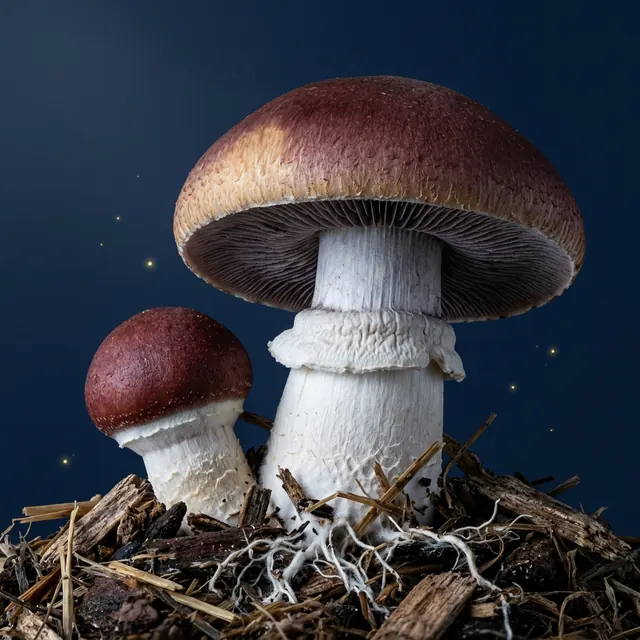
Wine cap
Stropharia rugosoannulata
Polish folk names: łysiczka uprawna, łysiczka trocinowa
How to recognise
- Cap 6–15 cm, up to 20 cm, smooth and matt, dark wine-brown when young, then ochre-brown to cream.
- Gills dense, pale grey, then grey-lilac to violet-black, with a paler edge.
- Stem 7–15 cm tall and 1.5–3 cm thick, white, with a thick, white ring.
- Spore print black-violet; white cords of mycelium at the base of the stem.
Up close
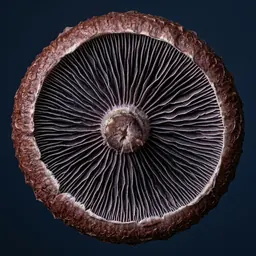 fioletowoczarne blaszki
Underside of the cap
Gills crowded, pale grey, grey-lilac to violet-black with age, with a paler edge.
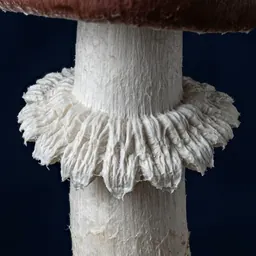 thick ring
Stem
Stem white, turning yellow with age, with a thick, white ring, grooved on the upper side.
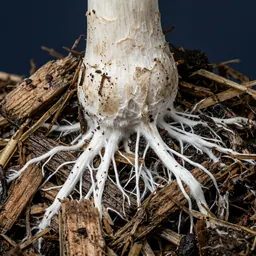 white cords
Base of the stem
Base sometimes widened, with white cords of mycelium growing into straw or wood chips.
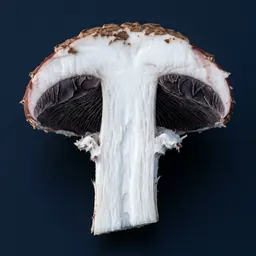 white flesh
Cross-section
Flesh white, firm, does not change colour.
The close-ups are AI illustrations. Any doubt is settled by a mycologist or herbalist, not by a photo.
Where and when it grows
Parks, allotment gardens, gardens, fields, less often forest; on the ground, rotted straw and garden waste. From May to September; its range is expanding in Poland.
JanFebMarAprMayJunJulAugSepOctNovDec
Most often under: straw, wood chips, gardens, fields, parks.
Beware of the lookalike
Pierścieniak okazały. Pierścieniak okazały grows in forests on coniferous wood, has little scales on the stem and a more delicate ring. Regarded as probably poisonous.
In the kitchen
Only well fried or cooked, because undercooked it causes digestive disorders. Fry in butter for at least 20 minutes or grill the slices.
Good to know
Cultivated in Poland since 1970. Undercooked, it causes digestive disorders.
Frequently asked questions
Is wine cap edible?
Warunkowo. Cultivated in Poland since 1970. Undercooked, it causes digestive disorders.
When does wine cap grow?
May – September. Parks, allotment gardens, gardens, fields, less often forest; on the ground, rotted straw and garden waste. From May to September; its range is expanding in Poland.
Wine cap: what is it easily confused with?
Most often with the species Pierścieniak okazały. Pierścieniak okazały grows in forests on coniferous wood, has little scales on the stem and a more delicate ring. Regarded as probably poisonous.