

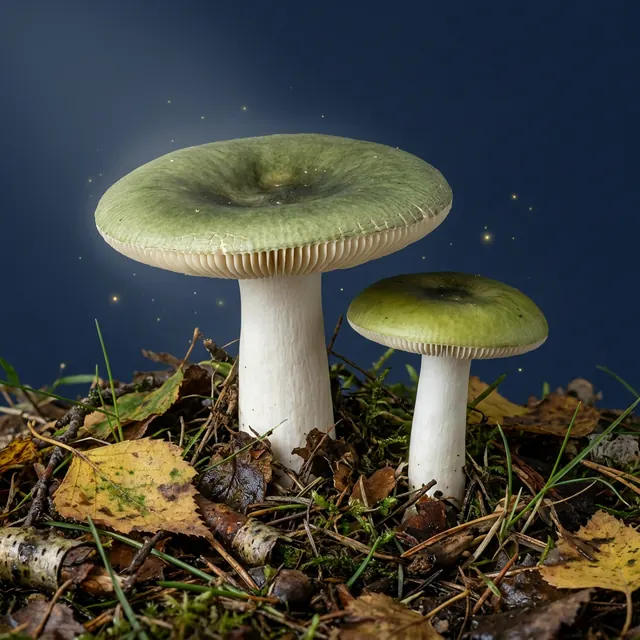
Tacky green russula
Russula aeruginea
Polish folk names: gołąbek grynszpanowy
How to recognise
- Cap 3–10 cm, green, olive-green to yellow-green, matt, darker in the centre; the skin peels off almost the whole cap.
- Gills crowded, white, cream in older ones; spore print light cream.
- Stem 4–8 cm tall and 1–2 cm thick, white, rusty-spotted at the base, without a ring.
- Flesh white and brittle, taste slightly burning, especially in the gills.
Where and when it grows
Deciduous, mixed and coniferous forests and parks, mainly under birches. From June to November; one of the most common russulas in Poland.
JanFebMarAprMayJunJulAugSepOctNovDec
Most often under: birch; less often beech, spruce, pine.
Beware of the lookalike
Death cap. The amanita has a hanging ring and a bulb in a white volva. The brittlegill has neither a ring nor a volva, and its flesh is white and brittle.
Feature-by-feature comparison: Tacky green russula or Death cap?
In the kitchen
Edible of lower quality, only after thorough heat treatment: boil, then fry. Boiling removes the bitter taste. Do not eat it in large amounts.
Good to know
The main risk is mistaking it for the deadly poisonous death cap. Raw or eaten in larger amounts it can cause gastrointestinal upset.
Frequently asked questions
Is tacky green russula edible?
Warunkowo. The main risk is mistaking it for the deadly poisonous death cap. Raw or eaten in larger amounts it can cause gastrointestinal upset.
When does tacky green russula grow?
June – November. Deciduous, mixed and coniferous forests and parks, mainly under birches. From June to November; one of the most common russulas in Poland.
Tacky green russula: what is it easily confused with?
Most often with the species Death cap. The amanita has a hanging ring and a bulb in a white volva. The brittlegill has neither a ring nor a volva, and its flesh is white and brittle.