

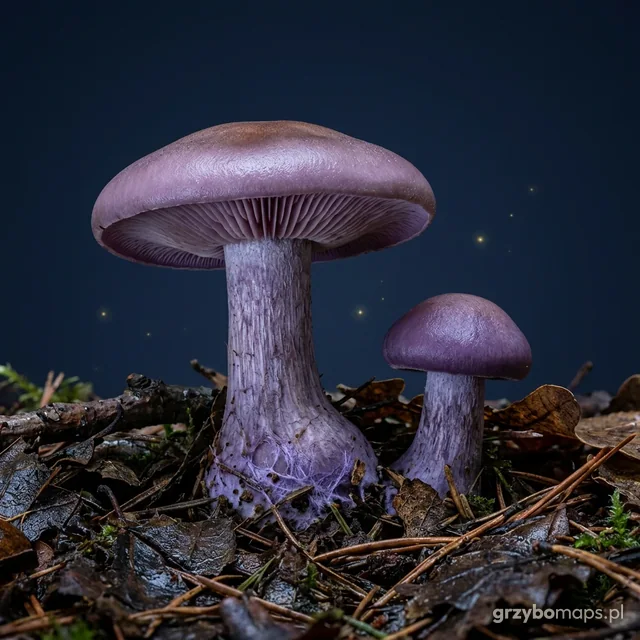
Wood blewit
Collybia nuda
Polish folk names: Lepista nuda, gąska fioletowa
How to recognise
- Cap 5–15 cm, smooth, violet when young, fading to brownish or ochre with age.
- Gills dense, violet, easily separating from the flesh.
- Stem violet, fibrous, often thickened at the base, without a ring or cortina.
- Smell fruity, pleasant; spore print pale pink.
Up close
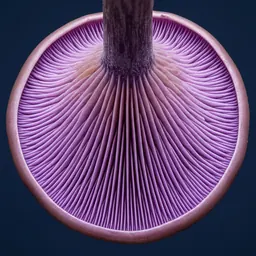 fioletowe blaszki
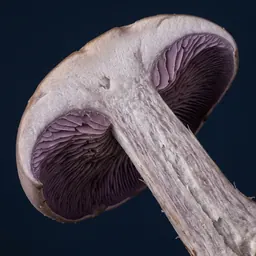
Underside of the cap
Gills dense, violet, easily separating from the flesh; no cobweb-like cortina.
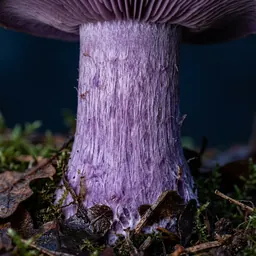 no cortina
Stem
Stem violet, fibrous, without a ring and without the rusty cortina fibres.
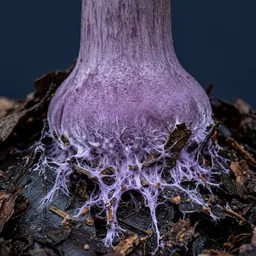 swollen
Base of the stem
Base swollen, with violet-ish mycelium; grows in leaf litter and compost.
 owocowy zapach
Cross-section
Flesh lilac-tinged, fruity smell. Spore print pale pink, not rusty as in webcaps.
The close-ups are AI illustrations. Any doubt is settled by a mycologist or herbalist, not by a photo.
Where and when it grows
Deciduous and coniferous forests, parks, compost heaps and thick layers of leaves; main flush from September to November, single fruiting bodies sometimes already in May.
JanFebMarAprMayJunJulAugSepOctNovDec
Most often under: beech, oak, spruce, pine; often in leaf litter and compost.
Beware of the lookalike
Violet webcaps (e.g. Cortinarius traganus). Young webcaps have a cobweb-like veil between the cap and the stem and a rusty-brown spore print that stains the stem. The wood blewit has no veil, and its spore print is pale pink.
Feature-by-feature comparison: Wood blewit or Violet webcap?
In the kitchen
Fry or stew for at least 15–20 minutes; good with onion, in sauces and scrambled eggs.
Good to know
Edible only after thorough boiling or frying – raw or undercooked it causes stomach complaints. Do not collect by roads (it accumulates heavy metals).
Where in Poland
Most records in the GBIF database: wielkopolskie, mazowieckie, śląskie, zachodniopomorskie, dolnośląskie.
Frequently asked questions
Is wood blewit edible?
Warunkowo. Edible only after thorough boiling or frying – raw or undercooked it causes stomach complaints. Do not collect by roads (it accumulates heavy metals).
When does wood blewit grow?
September – November. Deciduous and coniferous forests, parks, compost heaps and thick layers of leaves; main flush from September to November, single fruiting bodies sometimes already in May.
Wood blewit: what is it easily confused with?
Most often with the species Violet webcaps (e.g. Cortinarius traganus). Young webcaps have a cobweb-like veil between the cap and the stem and a rusty-brown spore print that stains the stem. The wood blewit has no veil, and its spore print is pale pink.
Where in Poland does wood blewit grow?
Most records (GBIF): wielkopolskie, mazowieckie, śląskie, zachodniopomorskie, dolnośląskie. Most often under: beech, oak, spruce, pine; often in leaf litter and compost.