

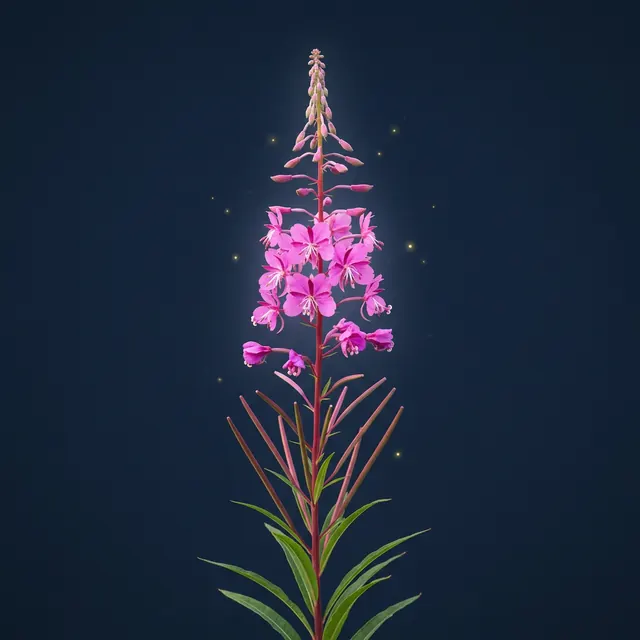
Rosebay willowherb
Chamaenerion angustifolium (L.) Schur
Polish folk names: wierzbówka wąskolistna, wierzbownica kiprzyca
Traditional use
Traditionally (EMA/HMPC, herb, synonym Epilobium angustifolium) in men with benign prostatic hyperplasia to relieve lower urinary tract symptoms, after serious diseases have been ruled out by a doctor. In Russia and England a tea substitute was made from the leaves, and the young shoots were eaten. A 2019 ethnobotanical study shows that today's fashion for it as a "men's" herb largely stems from new publications, not from old tradition.
What it looks like
Perennial 50–150 cm tall, forming stands in clearings, felled areas and by roadsides. Stem straight, often red. Leaves alternate, lanceolate, paler beneath, with lateral veins running off at almost a right angle. At the top, a long raceme of pink-purple flowers 2–4 cm across with 4 broad petals. Capsules up to 8 cm, seeds with white fluff.
Harvest
Gathered: herb (aerial parts), leaf, young shoots.
When: June – August.
Form: infusion, kitchen (young shoots).
Lookalikes
- purple loosestrife - 6-petalled flowers, opposite leaves; harmless
- willowherbs - smaller flowers, singly in the leaf axils; harmless
The information is educational and describes traditional use according to EMA/HMPC monographs (the European Medicines Agency and its Committee on Herbal Medicinal Products).It does not replace the advice of a doctor or pharmacist. Never eat a plant you are not 100% sure you recognise.