

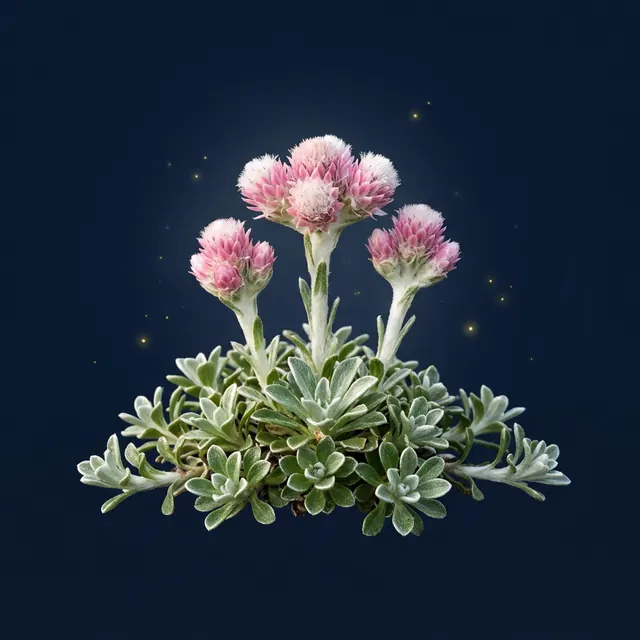
Mountain everlasting
Antennaria dioica (L.) Gaertn.
Polish folk names: kocie łapki, Flos Gnaphalii dioici
Traditional use
Rarely used in herbalism. Traditionally it was credited with antitussive, astringent, diuretic and coating effects: it was used for bronchitis, liver and gallbladder complaints and diarrhoea, and externally for gargling. In Romania it is known as a diuretic and choleretic. A 2018 study found a lot of chlorogenic acid in the flowers and antioxidant activity in the laboratory, but only weak antibacterial activity. There are no human studies and no EMA monograph.
What it looks like
Low perennial up to 20 cm, forming flat mats from creeping, densely leafy runners. Lower leaves spatula-shaped, up to 2 cm, silvery-white hairy beneath. Stems upright, with narrow leaves. At the top 3–8 flower heads in an umbel-like inflorescence. The plant is dioecious: female heads with pink to red involucral bracts, male ones smaller and whitish.
Harvest
Gathered: koszyczki kwiatowe, herb (aerial parts).
When: May – July.
Form: infusion, rinse.
Lookalikes
- sandy everlasting (Helichrysum arenarium) – yellow flower heads, taller stem; also a daisy-family plant, harmless
- edelweiss – star-shaped, felty bracts; protected, in Poland only in the Tatra Mountains
- strawflowers (dried flowers) – large, colourful flower heads

The information is educational and describes traditional use according to EMA/HMPC monographs (the European Medicines Agency and its Committee on Herbal Medicinal Products).It does not replace the advice of a doctor or pharmacist. Never eat a plant you are not 100% sure you recognise.