

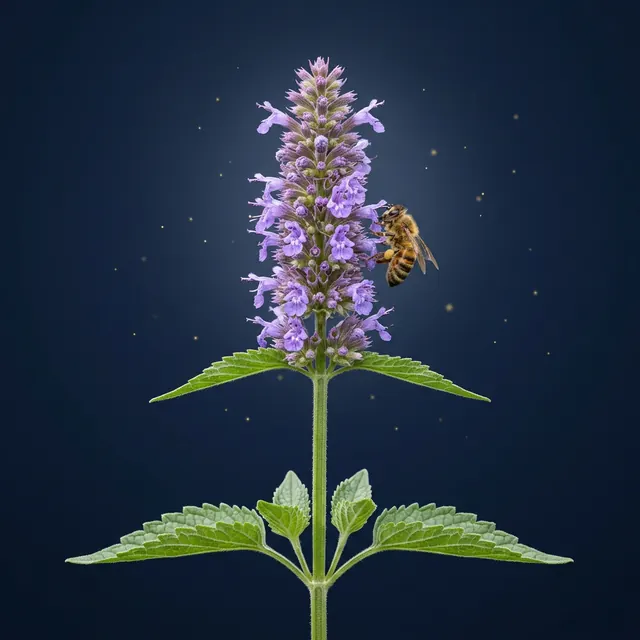
Anise hyssop
Agastache foeniculum (Pursh) Kuntze
Polish folk names: agastache
Traditional use
It comes from North America; in Poland it is grown in gardens as a honey plant and for brewing drinks. The leaves and flowers smell of anise and are edible raw and cooked. Native Americans (Cree, Cheyenne, Ojibwe) used an infusion for fever and respiratory complaints, and poultices for burns. There is no EMA monograph, and there are no clinical studies.
What it looks like
Upright perennial 0.6–1.2 m tall with four-angled stems. Leaves ovate, toothed, whitish beneath, smell of aniseed when crushed. From June to September, lilac flowers in dense, cylindrical spikes at the tips of the shoots, swarming with bees and bumblebees.
Harvest
Gathered: leaf, flower.
When: June – September.
Form: infusion, spice.
Lookalikes
- Korean mint – sometimes sold as anise hyssop; harmless
- hyssop – despite the English name, a different genus; harmless
The information is educational and describes traditional use according to EMA/HMPC monographs (the European Medicines Agency and its Committee on Herbal Medicinal Products).It does not replace the advice of a doctor or pharmacist. Never eat a plant you are not 100% sure you recognise.