

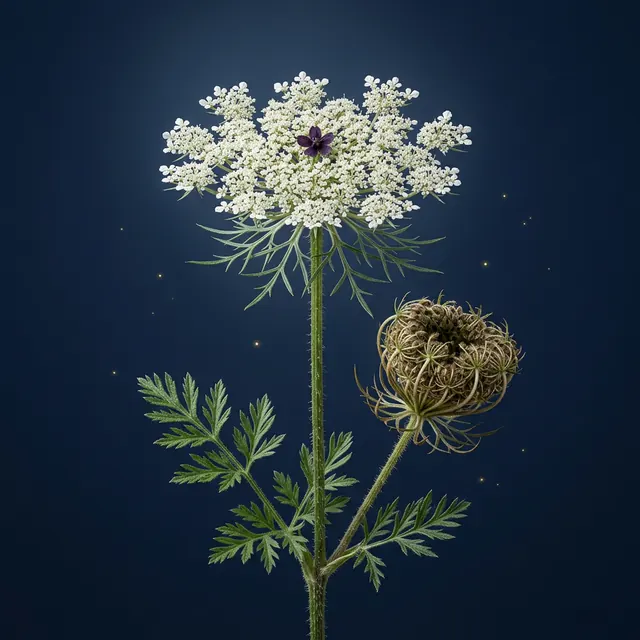
Wild carrot – the wild carrot
Daucus carota L. subsp. carota
Polish folk names: dzika marchew, marchew dzika
Traditional use
No EMA monograph. Wild carrot is the ancestor of the cultivated carrot. The young root is edible but quickly becomes woody; the flowers and seeds are sometimes used as a spice. There is no evidence of a medicinal effect. The most important thing with this plant is flawless identification, because its white umbels resemble deadly poisonous plants of the same family.
What it looks like
Biennial 25–150 cm tall, smells of carrot. Stem grooved and roughly hairy. Leaves hairy, 2–4 times pinnate. White flowers in a flat or convex compound umbel; in the centre there is often a single dark red flower. Beneath the umbel are numerous pinnately divided bracts, as long as the rays. After flowering the umbel curls up into a hollow “bird's nest”. Fruits small, with hooked spines. Root thin, whitish.
Harvest
Gathered: young root, flowers, fruits (seeds) as a spice.
When: May – September.
Form: kitchen.
Lookalikes
- Poison hemlock – DEADLY POISONOUS (coniine); stem BARE, bluish, with reddish or purple blotches, smells of mice when crushed; the root does not smell of carrot
- Fool's parsley (“dog parsley”) – POISONOUS; stem bare, leaves shiny underneath, one-sided bracteole leaflets hanging downwards beneath the umbels, no large involucre beneath the umbel
- Cowbane – DEADLY POISONOUS; grows by water, stem bare, rhizome with transverse chambers and yellow sap
- Sosnowsky's hogweed – burns (severe burns after sun exposure); gigantic, up to several metres, with enormous umbels
- Cow parsley and other white umbellifers – without a dark flower in the middle and without pinnate bracts
The information is educational and describes traditional use according to EMA/HMPC monographs (the European Medicines Agency and its Committee on Herbal Medicinal Products).It does not replace the advice of a doctor or pharmacist. Never eat a plant you are not 100% sure you recognise.