

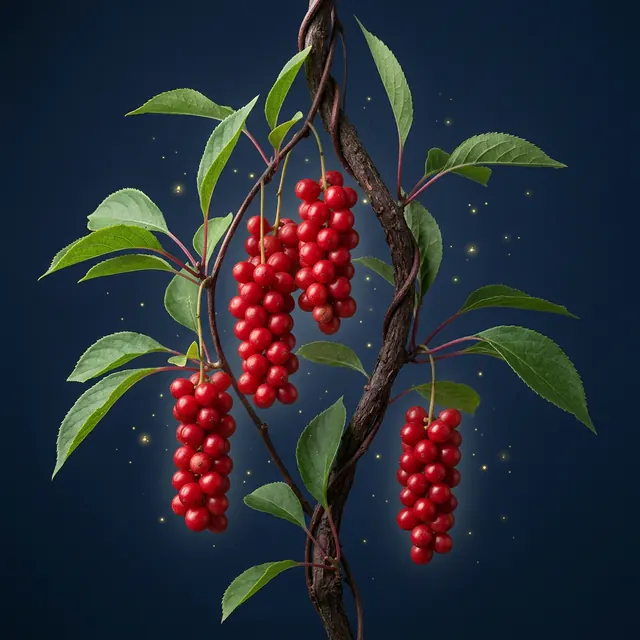
Schisandra
Schisandra chinensis (Turcz.) Baill.
Polish folk names: schizandra, owoc pięciu smaków, winorośl chińska
Traditional use
In Chinese and Russian medicine the “five-flavour” fruit was used for fatigue, cough, insomnia and digestive complaints. In Russia it was regarded as a stimulant. There are no strong clinical studies and no EMA monograph. In Asia the fruit is made into preserves and juices.
What it looks like
Climber up to 8–15 m, twining around tree trunks. Leaves elliptical, finely toothed, lemon-scented when crushed. Flowers creamy white, fragrant, hanging on long stalks. Fruits in an elongated, drooping cluster: 10–40 round, scarlet berries up to 1 cm across.
Harvest
Gathered: fruit, seeds.
Form: infusion, juice, preserve.
Lookalikes
- Redcurrant: similar clusters, but it is a shrub, not a climber, and has lobed leaves
- Bittersweet nightshade: climbing, with red berries, poisonous – it has purple flowers and egg-shaped berries in loose clusters
The information is educational and describes traditional use according to EMA/HMPC monographs (the European Medicines Agency and its Committee on Herbal Medicinal Products).It does not replace the advice of a doctor or pharmacist. Never eat a plant you are not 100% sure you recognise.