

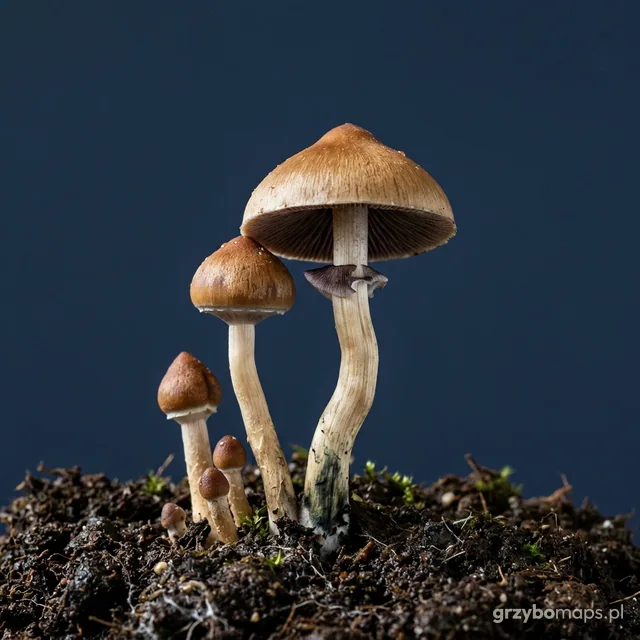
Psilocybin mushrooms in culture
Psilocybe spp. (m.in. Psilocybe mexicana, P. cubensis, P. caerulescens)
Polish folk names: teonanácatl („grzyb bogów”), magiczne grzyby, święte dzieci (niños santos), łysiczki
What it looks like
Small gilled mushrooms with a thin stem and a conical or bell-shaped cap in shades of brown, caramel or ochre, which lightens when dry. A characteristic feature of many species is the bluing of the flesh and stem after injury. The spore print is dark violet-brown.
Where it comes from
The ritual species come from Mexico and Central America (Oaxaca, the Sierra Mazateca mountains); the genus Psilocybe occurs all over the world, in Poland including the liberty cap (P. semilanceata) in meadows and pastures.
History
The Aztecs called the sacred mushrooms teonanácatl – “mushroom of the gods” (the popular translation “flesh of the gods” is wrong); Spanish chroniclers, including Bernardino de Sahagún, described their ceremonial consumption, and the Church fought against it. The ritual survived in hiding among the Mazatecs in Oaxaca. Their shaman (curandera) María Sabina led nocturnal healing ceremonies, the velada, with songs and prayers; in 1955 the American banker and ethnomycologist R. Gordon Wasson took part in one and described it in the article “Seeking the Magic Mushroom” in “Life” magazine (13 May 1957). The article triggered a wave of tourists and hippies in Huautla de Jiménez, which destroyed the community's peace – Sabina's house burned down, and she herself said that the mushrooms had “lost their power”. In 1958 Albert Hofmann isolated psilocybin from them.
Legend and truth
Myth: “María Sabina gladly shared the mushrooms with newcomers and encouraged them to use them”. In reality, for her they were a sacrament for healing the sick, not entertainment; at the end of her life she regretted having betrayed the secret to outsiders.
Substances
Psilocybin (converted in the body into psilocin), psilocin, baeocystin, norbaeocystin.
How it works
Psilocin stimulates 5-HT2A serotonin receptors, causing, after several tens of minutes, changes in perception, emotions and sense of self lasting several hours, with visions and an altered sense of time. These depend strongly on mindset and surroundings (set and setting). In two large phase III trials (2025–2026), psilocybin with therapeutic support produced a moderate but significant improvement in treatment-resistant depression, and Czechia has permitted it for treatment since 2026; outside such conditions, no one has tested its therapeutic effect.
What it is sometimes confused with
- funeral bell (Galerina marginata) – deadly poisonous
- fibrecaps (Inocybe) – poisonous
- mottlegills (Panaeolus)
- other small brown mushrooms
Law in Poland
Psilocybin and psilocin are psychotropic substances of group I-P (the strictest) in Poland, and possessing mushrooms that contain them is punishable.
Fun fact
The word “psychedelic” was coined shortly after Wasson's article (1957), and Wasson himself went down in history as the J.P. Morgan banker who started the Western “mushroom revolution”.
What research really says
Psilocybin has low physical toxicity and very rarely ends in a visit to the emergency department, but it strongly affects the mind, so the main risks are panic, accidents and misidentifying the species when foraging. Clinical trials on depression are promising, although the effects are smaller than the headlines suggest.
How often it ends in the emergency department
In the Global Drug Survey 2017, of 9233 people who had eaten psilocybin mushrooms in the past year, 19 (0.2%) sought emergency medical help; the risk per use was estimated at 0.06%. The most common problems were anxiety, panic and paranoia, and almost everyone returned to normal within 24 hours. Young people were at the highest risk, and the most common causes were a poor mental state, a bad setting and mixing substances.
Deaths
A Dutch review (Regulatory Toxicology and Pharmacology, 2011) found only two deaths in the literature from an overdose of the mushrooms alone, without other substances. The other reported deaths were linked to alcohol or other drugs, or to accidents, e.g. falls from a height. The authors concluded that the mushrooms carry a relatively low risk, but that unpredictable panic attacks are a real problem.
Depression: what the trials showed
In a 2022 NEJM trial (233 people with treatment-resistant depression), a single high dose of psilocybin with psychological support lowered the MADRS score by 6.6 points more than the control dose after 3 weeks, but the effect weakened by 12 weeks. Two large phase III trials by the company Compass (2025 and 2026, results announced by the company, not yet peer-reviewed) met their goal, with a difference versus control of approx. 3.6–3.8 MADRS points, which is a moderate effect. In a 2021 trial comparing psilocybin with escitalopram (59 people), there was no significant difference in the primary outcome.
The limits of these studies
Participants usually know whether they received psilocybin, because its effects are hard to miss, so expectations can inflate the results. In the 2022 trial, suicidal thoughts and self-harm appeared more often in the higher-dose groups. The trials are conducted on selected patients under constant care from therapists, so their results cannot be transferred to unsupervised use.
Microdosing
In a self-blinding study (eLife 2021, 191 people), the improvement in well-being was the same in the group taking microdoses and in the placebo group. In a double-blind trial (Translational Psychiatry 2022, 34 people), there was no improvement in creativity, cognitive function or well-being, and noticeable effects were reported mainly by those who guessed what they had received. Most positive opinions about microdosing come from users' own accounts.
Mental health in the population, and lithium
In an analysis of over 135 thousand American adults (2015), use of classic psychedelics was not associated with a higher rate of mental disorders or suicide attempts, although the methodology of this paper has been criticised. This applies to the general population, not to people predisposed to psychosis or bipolar disorder. In 62 online reports on combining psychedelics with lithium, 47% described seizures.
Where it is legal as a medicine
Since 1 January 2026, Czechia has allowed specialised facilities to use synthetic psilocybin in patients with severe depression when other treatment has failed. In Poland, psilocybin is still in group I-P, i.e. substances deemed to have no medical use.
Authorities vs data
- Authorities exaggerate. They say: Polish law places psilocybin in group I-P, alongside LSD and MDMA, i.e. among substances with no recognised medical use. Data: Two phase III trials in treatment-resistant depression met their goals, and Czechia has approved psilocybin for treatment from 2026.
- Authorities exaggerate. They say: In its psilocybin leaflet, the US DEA lists possible death among the effects of an overdose. Data: A 2011 review found only two deaths from overdose alone; 0.2% of past-year users sought medical help, almost always because of anxiety that passed within a day.
- Consistent with research. They say: The DEA warns that poisonous mushrooms are sometimes mistaken for psilocybin mushrooms. Data: As early as 1990, Danish doctors described poisonings by more dangerous species mistaken for the liberty cap; this is one of the main real risks.
What we don't know yet. It is not known how long the antidepressant effect lasts after one or two sessions, or how much of it is down to patients' expectations. There are also no good data on exactly who psilocybin may push into psychosis.
Knowledge, not encouragement. We do not give doses or preparation methods.
Card in the mushroom atlas: Liberty cap
Frequently asked questions
How does psilocybin mushrooms in culture work?
Psilocin stimulates 5-HT2A serotonin receptors, causing, after several tens of minutes, changes in perception, emotions and sense of self lasting several hours, with visions and an altered sense of time. These depend strongly on mindset and surroundings (set and setting). In two large phase III trials (2025–2026), psilocybin with therapeutic support produced a moderate but significant improvement in treatment-resistant depression, and Czechia has permitted it for treatment since 2026; outside such conditions, no one has tested its therapeutic effect.
What are the risks of psilocybin mushrooms in culture?
Dangerous. The main risks are acute anxiety reactions, panic, disorientation and dangerous behaviour (falls, running away, accidents), and in predisposed people, triggering psychosis. The most serious danger when foraging on your own is mistaking little brown mushrooms for deadly poisonous ones, e.g. the funeral bell (Galerina marginata), which contains amatoxins. Combining with medicines can be dangerous: in 47% of 62 reports on combining psychedelics with lithium, seizures were described.
Psilocybin mushrooms in culture and the law in Poland: what is allowed?
Psilocybin and psilocin are psychotropic substances of group I-P (the strictest) in Poland, and possessing mushrooms that contain them is punishable.
Sources
- Grzyby psylocybinowe – Wikipedia
- María Sabina – Wikipedia (EN)
- María Sabina – Erowid
- Psylocyna – Wikipedia
- Grzyby halucynogenne – EUDA (Drugs in focus, PL)
- Kopra i in.: Adverse experiences resulting in emergency medical treatment seeking following the use of magic mushrooms (2022)
- van Amsterdam i in.: Harm potential of magic mushroom use: a review (2011)
- Goodwin i in.: Single-Dose Psilocybin for a Treatment-Resistant Episode of Major Depression (NEJM 2022)
- Compass Pathways: drugie badanie III fazy COMP360 osiąga cel (2026)
- Imperial College: psylocybina a escitalopram (2021)
- Szigeti i in.: Self-blinding citizen science to explore psychedelic microdosing (eLife 2021)
- Cavanna i in.: Microdosing with psilocybin mushrooms: a double-blind placebo-controlled study (2022)
- Johansen, Krebs: Psychedelics not linked to mental health problems or suicidal behavior (2015)
- Nayak i in.: Classic psychedelic coadministration with lithium (Pharmacopsychiatry 2021)
- Medical use of magic mushrooms to become legal in Czechia from 2026