

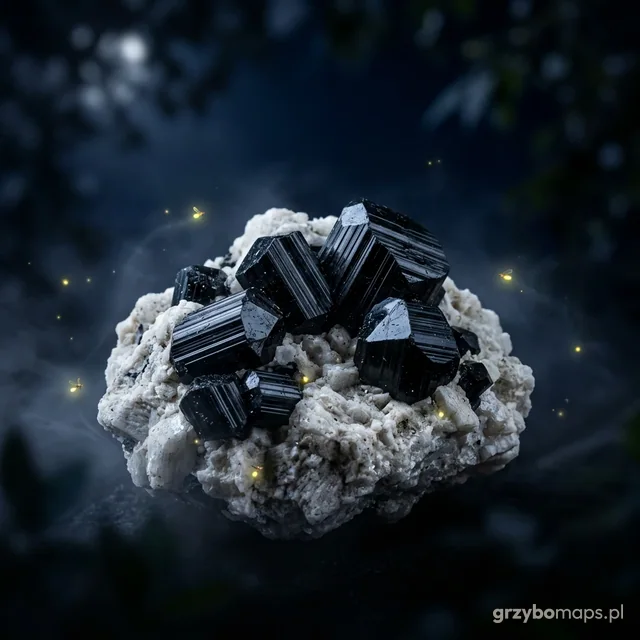
Tourmaline (schorl)
The black, iron-rich variety of tourmaline, a complex boron silicate.
Black needles and columns of schorl sit in the granite pegmatites of Strzegom and the Karkonosze. It is the most common tourmaline in Poland.
What it is
The black, iron-rich variety of tourmaline, a complex boron silicate.
How to recognise
- Black, shiny columns with a triangular cross-section with convex sides.
- Lengthwise striations along the crystal.
- Harder than glass, no cleavage.
- Hornblende (an amphibole) cleaves at an angle of about 120° and has a rhombic cross section.
How and where to look
In coarse-grained pegmatites on granite quarry dumps and in boulders in streams. The Geological and Mining Law (art. 4) does not cover collecting specimens of minerals, rocks and fossils for collecting, scientific and educational purposes, as long as it is done without mining works. Collecting minerals and fossils is prohibited in nature reserves and national parks (Nature Conservation Act, art. 15). On someone else's land, in a forest and in a quarry, you need permission from the owner, the forest district or the manager.
Known places in Poland
- Strzegom area (woj. dolnośląskie): Granite quarries, with the operator's permission.
- Szklarska Poręba (woj. dolnośląskie): Outside Karkonosze National Park.
Meaning and legends
Dutch traders brought tourmalines from Ceylon and noticed that when heated they attract ash; they called them 'aschentrekker'. This is a real property: pyroelectricity.
Fun fact
When heated or squeezed, tourmaline becomes electrically charged at the ends of the crystal.