

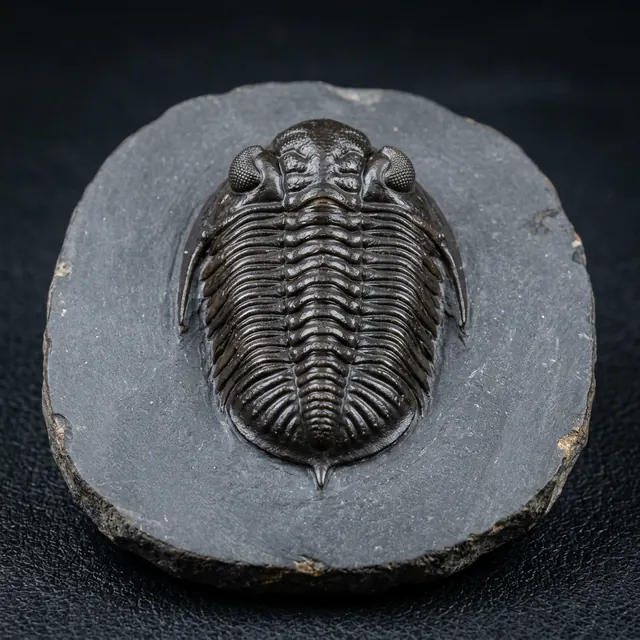
Trilobite
A fossil of an extinct marine arthropod of the class Trilobita, which lived from the early Cambrian to the end of the…
An oval, flattened animal with a head shield, thorax and tail shield, divided by two furrows into three lobes. In the Holy Cross Mountains, trace fossils of trilobites are known from the Upper Cambrian quartzite sandstones of Wiśniówka near Kielce, as well as trilobites from the Devonian limestones of Kadzielnia. Most often single shields are found, not whole carapaces.
What it is
A fossil of an extinct marine arthropod of the class Trilobita (trilobites), which lived from the early Cambrian to the end of the Permian.
How to recognise
- Three lobes running along the body: a convex central one and two side ones.
- Head shield with a convex glabella and often with eyes; thorax made of many segments.
- Curled-up specimens look like a little ball, because many trilobites rolled up when threatened.
- Trilobite traces on the underside of layers include bilobed resting hollows (Rusophycus) and crawling furrows (Cruziana).
How and where to look
Look on spoil heaps and in loose rock blocks in pits, with the manager's permission, especially on the surfaces of sandstone layers. The traces are best seen in slanting light in the morning or evening. A helmet, goggles and gloves are the basics. The Geological and Mining Law (art. 4) does not cover the collecting of specimens of minerals, rocks and fossils for collecting, scientific and educational purposes, provided it is done without mining works. In nature reserves and national parks, collecting minerals and fossils is prohibited (Nature Conservation Act, art. 15). On other people's land, in a forest and in a quarry you need the consent of the owner, the forest district or the manager.
Known places in Poland
- Wiśniówka near Kielce (Wiśniówka Duża quarry) (woj. Świętokrzyskie): An active quartzite quarry of the company Kieleckie Kopalnie Kwarcytu: entry only with the mine's permission and with a guide. Next to it is a flooded, disused pit; do not go near the edge.
- Kadzielnia Nature Reserve, Kielce (woj. Świętokrzyskie): Strict reserve: viewing from the paths only; collecting fossils is prohibited.
- Geoeducation Centre (Geonatura Kielce) (woj. Świętokrzyskie): The city's educational institution (ul. Daleszycka 21) that looks after the Kadzielnia, Wietrznia and Ślichowice reserves; here you will learn the geology of the region.
Meaning and legends
Trilobites are good index fossils: on their basis the Cambrian is divided into smaller intervals, e.g. the genus Holmia is typical of the Lower Cambrian, and Olenus of the Upper. In 1963 Andrzej Radwański and Piotr Roniewicz described a rich assemblage of Late Cambrian trilobite traces from Wiśniówka.
Fun fact
The lenses of trilobite eyes were made of calcite crystals, and a single eye could have as many as 15,000 lenses.