

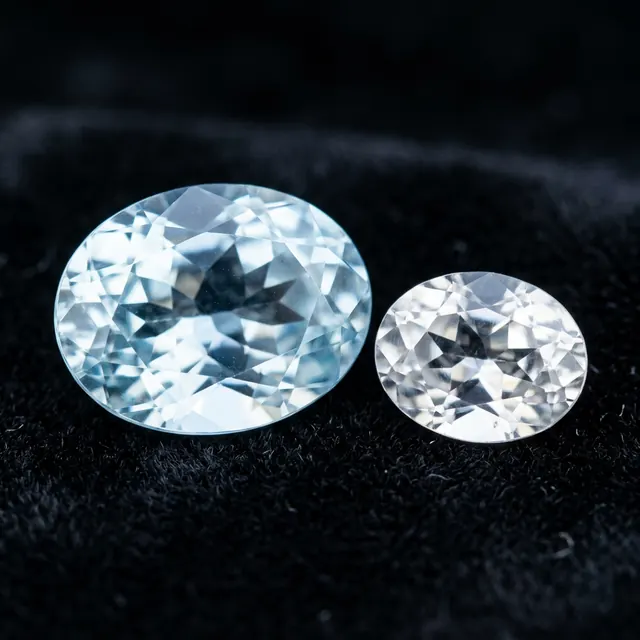
Topaz
Aluminium silicate with fluorine, Al2[SiO4]2
A gemstone with prismatic crystals with vertical striations on the faces. In Poland known from the pegmatites of Strzegom and Borów, from Kamień near Mirsk, Michałowice near Szklarska Poręba and Biały Kościół near Strzelin.
What it is
Aluminium silicate with fluorine, Al2[SiO4](F,OH)2; a mineral of pegmatites and greisens.
How to recognise
- Prismatic crystals with distinct vertical striations on the faces.
- Very hard (8): it scratches quartz.
- One perfect cleavage across the length of the crystal, a smooth fracture plane.
- Clearly heavier than quartz (density 3.4-3.6 g/cm3, quartz 2.65 g/cm3).
How and where to look
Topazes in Poland are small and rare; they are sought in the cavities of pegmatites, usually together with smoky quartz, feldspars and mica. A 10x loupe helps. Work wearing a helmet and goggles, away from the walls of the excavation. Geological and mining law (art. 4) does not cover the collecting of specimens of minerals, rocks and fossils for collecting, scientific and teaching purposes, if it is done without mining works. In nature reserves and national parks, collecting minerals and fossils is forbidden (Nature Conservation Act, art. 15). On someone else's land, in a forest and in a quarry, the permission of the owner, the forest district or the manager is required.
Known places in Poland
- Strzegom (woj. dolnośląskie): Pegmatites in granite; active, private quarries, entry only with the manager's permission.
- Michałowice near Szklarska Poręba (Piechowice) (woj. dolnośląskie): A site mentioned in the literature; the area borders the Karkonosze National Park, where collecting is forbidden.
- Biały Kościół near Strzelin (woj. dolnośląskie): The Strzelin granite area; the quarries are private, ask for permission.
Meaning and legends
The name probably comes from the Greek topazios, and some derive it from the island of Topazios in the Red Sea. The name is also linked to an old Sanskrit word meaning fire, from the orange-golden colour of the precious varieties. Attributing protective powers to topaz is belief, not fact.
Fun fact
Blue topazes in shops are usually made by irradiating colourless stones; they have little value and may fade over time.