

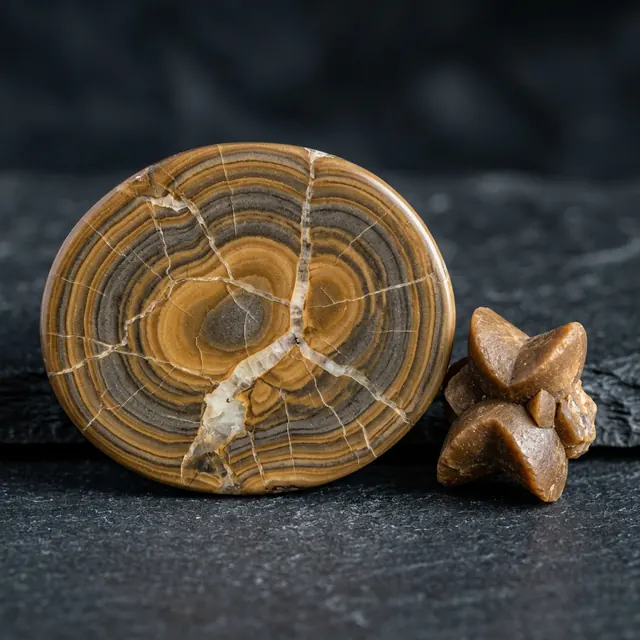
Siderite (spherosiderite)
Iron carbonate, FeCO3
A yellow-brown to brown mineral containing almost 48% iron. In the Częstochowa region, clay siderites were mined for centuries; at various times 68 mines operated here, and the last one, Wręczyca, was closed in 1982. It also occurs around Łęczyca, Kłobuck and Wieluń, in the Góry Świętokrzyskie and in the Carpathian flysch.
What it is
Iron(II) carbonate, FeCO3; formerly an important iron ore, in clays it forms concretions called spherosiderites.
How to recognise
- Brown, heavy (3.7-4 g/cm3) lumps and loaf-shaped concretions in grey clays and mudstones.
- Crystals usually rhombohedral in shape; perfect cleavage.
- Streak white to light yellow.
- Calcite is lighter and clearly less heavy; limonite has a yellow-brown streak.
How and where to look
Look for concretions on the dumps of old mines and in brickyard pits where ore-bearing clays are exposed, always with the manager's permission. A geological hammer and protective goggles help. Geological and mining law (art. 4) does not cover the collecting of specimens of minerals, rocks and fossils for collecting, scientific and teaching purposes, if it is done without mining works. In nature reserves and national parks, collecting minerals and fossils is forbidden (Nature Conservation Act, art. 15). On someone else's land, in a forest and in a quarry, the permission of the owner, the forest district or the manager is required.
Known places in Poland
- Museum of Iron Ore Mining, Częstochowa (Staszic Park) (woj. śląskie): A museum operating since 1989; a good place to see the ore and the history of the mines.
- Gnaszyn Górny (Częstochowa), former mine dumps (woj. śląskie): Dumps of former iron ore mines; the land has owners, do not dig and do not climb steep, overgrown slopes.
Meaning and legends
In the Częstochowa land, ore was mined from the 14th century, and mining and metallurgy shaped the region; the coats of arms of Konopiska, Poczesna and Blachownia, among others, refer to this tradition. The name comes from the Greek sideros, meaning iron.
Fun fact
The original name of the mineral was spherosiderite (J. F. L. Hausmann, 1813); today this name is used for spherical siderite concretions in clays.