

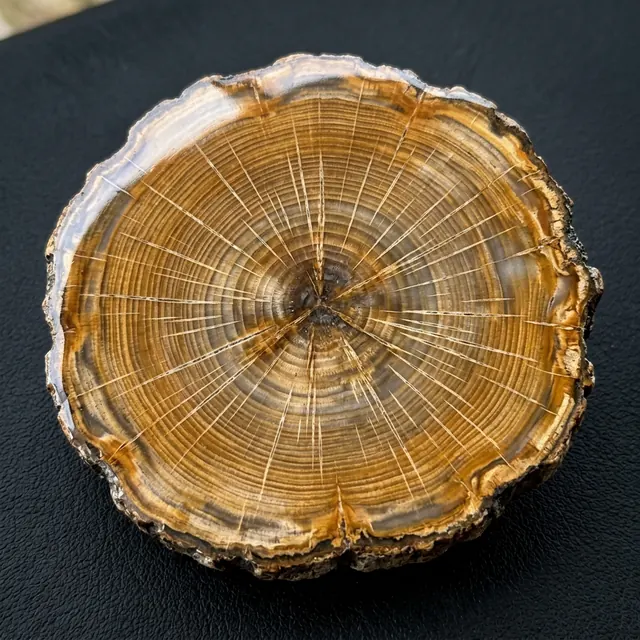
Silicified wood
Petrified wood in which the organic matter has been replaced by silica, often with the ring structure preserved.
In Poland the largest concentration of petrified trunks of Tertiary trees is in Siedliska in Roztocze. These are Miocene conifers of the genus Taxodioxylon. Older, Late Carboniferous and Early Permian Dadoxylon trunks are common near Nowa Ruda in Lower Silesia and west of Kraków.
What it is
Petrified wood in which the organic matter has been replaced by silica (chalcedony or opal), often with the ring structure preserved.
How to recognise
- It looks like a piece of trunk or branch: you can see growth rings, wood rays and fibres.
- Heavy and hard as stone: it scratches glass and cannot be scratched with a knife.
- Colours from grey and brown to red and yellow when the silica is tinted.
- Bog oak from river deposits is only slightly silicified and is still used to make furniture.
How and where to look
Fragments turn up in the fields of Roztocze between Siedliska, Hrebenne and Lubycza Królewska, and near Goraj and Chrzanów, always with the farmer's permission. Do not dig trunks out of the soil. The Geological and Mining Law (art. 4) does not cover the collecting of specimens of minerals, rocks and fossils for collecting, scientific and educational purposes, provided it is done without mining works. In nature reserves and national parks, collecting minerals and fossils is prohibited (Nature Conservation Act, art. 15). On other people's land, in a forest and in a quarry you need the consent of the owner, the forest district or the manager.
Known places in Poland
- Siedliska (Roztocze), petrified wood museum (woj. lubelskie): A village with a petrified wood museum; look at the specimens in the museum and, with the field owners' permission, in the fields.
- Jalinka Reserve near Siedliska (woj. lubelskie): The reserve protects, among other things, petrified trees in the soil; there is a trail called the Petrified Trees Trail. Collecting and digging are prohibited.
- Nowa Ruda (woj. dolnośląskie): An area of Dadoxylon trunks from the Late Carboniferous and Early Permian; the fields and spoil heaps have owners, ask for permission.
Meaning and legends
The oldest mention of silicified trees from Polish lands comes from Jan Długosz's chronicle of 1480, which describes trunks from Roztocze. Petrified wood museums operate in Siedliska and Bondyrz, and in Dąbrowa Tarnowska there is the Museum of Agates and Petrified Trees.
Fun fact
In the cavities of silicified wood there is sometimes crystalline quartz, even amethyst.