

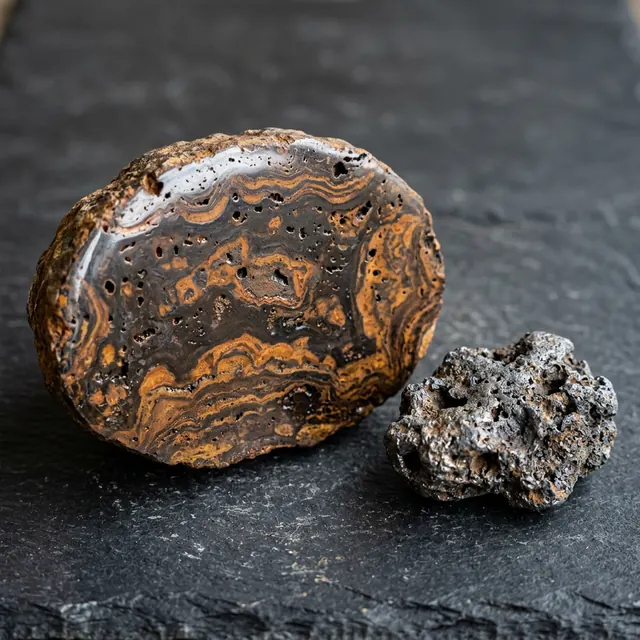
Bog iron ore (limonite)
Precipitates of hydrated iron oxides in the soil of waterlogged depressions, cementing sand and plant remains.
It forms in damp meadows and valleys where the level of iron-rich groundwater often fluctuates. It takes the form of black-brown lumps or a hard layer beneath the turf. Since prehistoric times iron was smelted from it, mainly in bloomery furnaces; in Poland until 1964.
What it is
Precipitates of hydrated iron oxides (limonite) in the soil of waterlogged depressions, cementing sand and plant remains.
How to recognise
- Black-brown to rusty, porous and holey lumps, often with root impressions and sand grains.
- It forms scattered lumps or a compact layer in the soil that is hard to penetrate.
- Streak yellow-brown (a trait of limonite), on a fresh break earthy or semi-metallic.
- Slag from a bloomery is glassy, vesicular and shows signs of melting; the ore is dull and earthy.
How and where to look
Lumps of ore surface on ploughed, damp meadows, in drainage ditches and on valley edges, especially after drainage works. Enter only with the permission of the owner or the ditch manager. Do not dig in protected peat bogs and wetlands. Geological and mining law (art. 4) does not cover the collecting of specimens of minerals, rocks and fossils for collecting, scientific and teaching purposes, if it is done without mining works. In nature reserves and national parks, collecting minerals and fossils is forbidden (Nature Conservation Act, art. 15). On someone else's land, in a forest and in a quarry, the permission of the owner, the forest district or the manager is required.
Known places in Poland
- Museum of Ancient Masovian Metallurgy, Pruszków (woj. mazowieckie): A museum of the Masovian Metallurgical Centre, which was based on local bog iron ores.
- Church of St Lawrence in Studzieniec (woj. lubuskie): A church from the second half of the 13th century built of stone and bog iron ore; for viewing only, do not chip off pieces of the walls.
- Nowa Słupia (Dymarki) (woj. Świętokrzyskie): In mid-August, demonstrations of iron smelting in bloomery furnaces.
Meaning and legends
The Masovian Metallurgical Centre near Pruszków was one of the largest smelting centres of barbarian Europe; it is estimated that 120-150 thousand smelts were carried out there, with production peaking in the 1st-2nd centuries AD. The bloomery furnaces were single-use, so today they can be counted.
Fun fact
Deposits of bog iron ore can renew themselves within a few years. In the past it was also used to purify gas of hydrogen sulphide.