

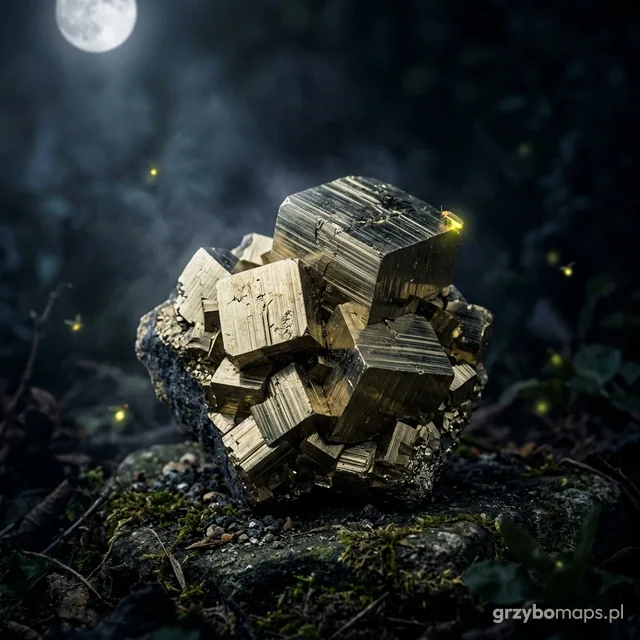
Pyrite
Iron sulphide, known as 'fool's gold'.
Brass-yellow cubes and grains of pyrite occur in many rocks in Poland. In Rudki in the Holy Cross Mountains there was a pyrite and iron ore mine.
What it is
Iron sulphide (FeS2), known as 'fool's gold'.
How to recognise
- Brass-yellow, metallic lustre; cubic crystals with striations.
- Hard: it scratches glass and strikes sparks.
- Streak black-green.
- Gold is soft and has a yellow streak; chalcopyrite is softer and more golden, often with an iridescent tarnish.
How and where to look
In shales, clays and quarries, on the dumps of former mines. Store in a dry place, because moisture decomposes it. The Geological and Mining Law (art. 4) does not cover collecting specimens of minerals, rocks and fossils for collecting, scientific and educational purposes, as long as it is done without mining works. Collecting minerals and fossils is prohibited in nature reserves and national parks (Nature Conservation Act, art. 15). On someone else's land, in a forest and in a quarry, you need permission from the owner, the forest district or the manager.
Known places in Poland
- Rudki (Nowa Słupia municipality) (woj. Świętokrzyskie): Former pyrite and iron ore mine; dumps, only with permission.
Meaning and legends
The name comes from the Greek pyr (fire), because struck it gives off sparks; it was used to light fires. 'Fool's gold' deceived gold prospectors.
Fun fact
Sulphuric acid was produced from the pyrite in Rudki.