

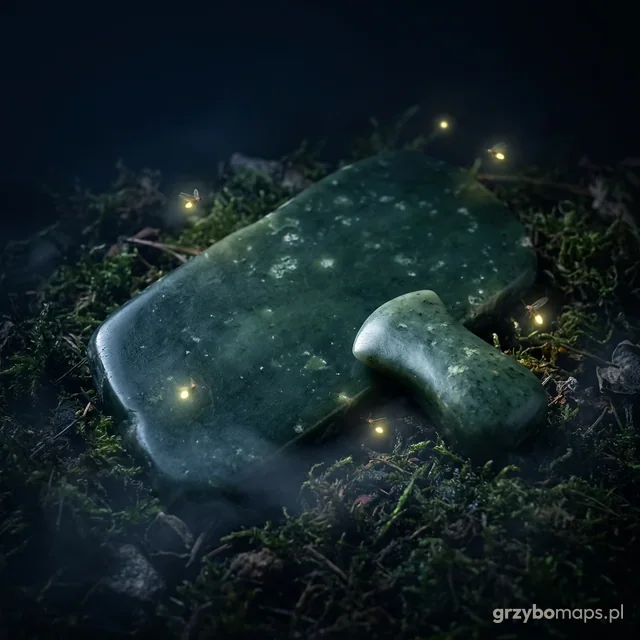
Nephrite
A compact, fibrous rock made of minerals of the amphibole group
The nephrite deposit at Jordanów Śląski was discovered by H. Traube in 1885. It forms nests and veins in the serpentinites of the Nasławice Hills. It is one of the few nephrite deposits in Europe.
What it is
A compact, fibrous rock made of minerals of the amphibole group (tremolite-actinolite); together with jadeite, one of the two stones called jade in English.
How to recognise
- Dark green with lighter streaks, a greasy lustre when polished.
- Exceptionally hard to break, because it is built of tangled fibres.
- Heavy in the hand.
- Serpentinite is much softer (a knife scratches it) and slipperier; chrysoprase is lighter and translucent.
How and where to look
Look for heavy green fragments in the fields and on the spoil heaps around Jordanów and Nasławice. You will recognise them by the way a hammer bounces off them. The Geological and Mining Law (art. 4) does not cover obtaining specimens of minerals, rocks and fossils for collecting, scientific and educational purposes, if this is done without mining works. In nature reserves and national parks, collecting minerals and fossils is prohibited (Nature Conservation Act, art. 15). On someone else's land, in a forest and in a quarry, you need the permission of the owner, the forest district or the manager.
Known places in Poland
- Jordanów Śląski (woj. dolnośląskie): A former quarry about 2 km west-northwest of the village on the slope of the Nasławice Hills; private land, ask for permission.
- Nasławice (woj. dolnośląskie): An active serpentinite quarry where a nephrite zone has been exposed; entry only with the company's permission.
Meaning and legends
Nephrite from Lower Silesia was used for axes in the Neolithic. The name comes from the Greek nephros (kidney), because it was once believed to cure the kidneys; that is a belief, not a medical fact.
Fun fact
In the 1970s the 'Skała' enterprise in Jordanów made jewellery from nephrite.