

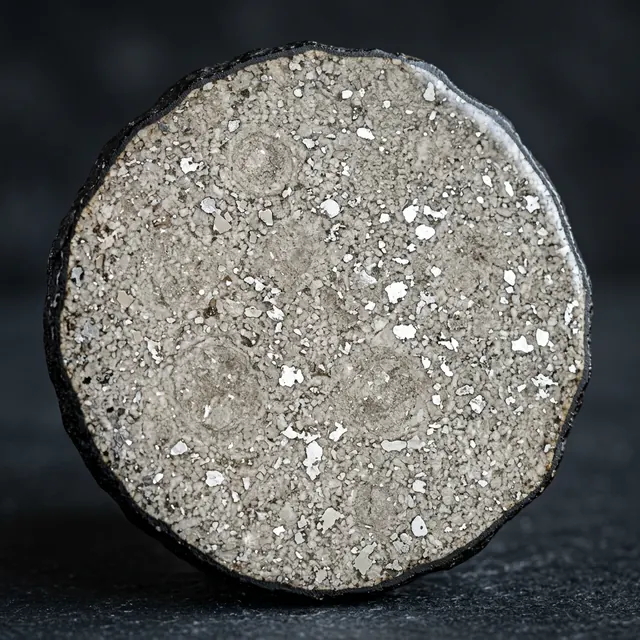
Sołtmany meteorite
A stony meteorite, an ordinary chondrite of type L6, which fell on 30 April 2011 in Masuria.
At 6:03 in the morning a fist-sized stone pierced the roof of an outbuilding at an agritourism farm in the village of Sołtmany near Giżycko and broke into two pieces. The whole weighed 1066 g. The age of the meteorite was estimated at 4.137 billion years.
What it is
A stony meteorite, an ordinary chondrite of type L6, which fell on 30 April 2011 in Masuria.
How to recognise
- A fresh meteorite has a thin, black, matte fusion crust.
- On a fresh break the interior is light grey with tiny balls (chondrules) and glittering grains of metal.
- It usually attracts a magnet, because it contains iron with nickel.
- Slag is vesicular and glassy, and ordinary stones have no fusion crust.
How and where to look
Meteorites cannot be planned for; your best chance is to report a sighting of a bright fireball quickly and to search after the fall, with the landowners' permission. Searching is prohibited in reserves and national parks, and searching with a metal detector for historical objects requires the conservator's permit. Report a find to scientists, e.g. the Polish Meteorite Society or the Earth Museum of the Polish Academy of Sciences.
Known places in Poland
- Sołtmany (Kruklanki municipality) (woj. Warmian-Masurian): The fall site is on a private farm; do not enter without the owners' permission.
- PAN Museum of the Earth, Warsaw (woj. mazowieckie): Fragments of the Sołtmany meteorite are in the collection; the museum also has a large collection of meteorites.
Meaning and legends
Fragments went to, among others, the University of Silesia, Wrocław University of Science and Technology, the Earth Museum of the Polish Academy of Sciences, Adam Mickiewicz University in Poznań, the Geological Museum of the Polish Academy of Sciences in Kraków and the Nicolaus Copernicus Museum in Frombork. An entire issue (no. 2, 2012) of the journal Meteorites was devoted to the meteorite. Old beliefs regarded stones from the sky as signs from the gods; this is tradition, not fact.
Fun fact
The owner of the farm heard a whistle and a bang, and a moment later found a hole in the roof and the shattered stone a few metres away.